
Why People Are Being Illegally Detained at the Border Between "Friendly" and "Cooperating" Abkhazia and Russia
23/12/2020 10:19:18 Conflicts
Back in 2009, Russia and Abkhazia signed a rather peculiar agreement "On Joint Efforts in Guarding the State Border of the Republic of Abkhazia." Why peculiar? Because the provisions of the document speak not so much of the joint guarding of the state borders of two countries, as of the unilateral subordination of all Abkhazian structures to the Border Directorate of Russia's FSB — established in Abkhazia for precisely this purpose.
At the time, in 2009, this veiled subjugation was described as an intention to develop friendly relations and mutually beneficial cooperation on the basis of universally recognized principles and norms of international law, in pursuit of the provisions of the Treaty on Friendship, Cooperation and Mutual Assistance between the Russian Federation and the Republic of Abkhazia of September 17, 2008, proceeding from their shared interest in security and stability on the state border of the Republic of Abkhazia. Yet beneath this weighty and resonant heading lay nothing more than the straightforward appropriation of Abkhazian land.
Under this very respectable pretext, the Abkhazian side was obligated to provide the Russian Border Directorate with documented rights to the free use of land plots and real property that are the property of the Republic of Abkhazia (Article 7). Moreover, this document fully shielded Russian military personnel from any form of punishment — even in the event that they violated Abkhazian law, say, by killing thousands of civilians (Article 12).
Russian military personnel were also exempted from paying all types of taxes, duties, levies, and other similar payments established by the legislation of the Republic of Abkhazia (Article 13).
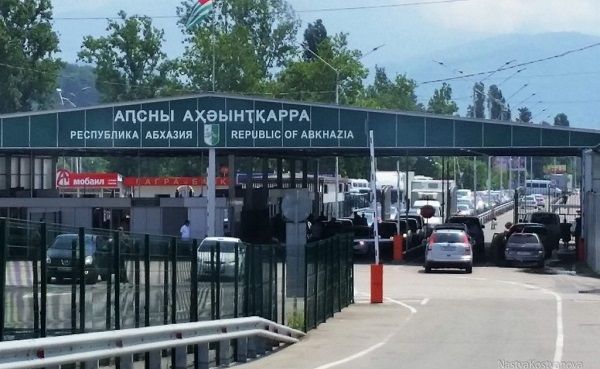
What prompted me to revisit this not particularly lengthy document were stories that have been troubling Abkhazian society for several months — all of them connected to the state border along the Psou River, the very same border where Abkhazia's residents stand for hours in traffic jams, on foot and in vehicles.
If you read the documents on joint border guarding signed after 2009, you will find that very little has changed in them — merely some formulations and the scope of interaction. What has not changed is Abkhazia's obligations toward the Russian Federation. Since 2009, not one of these documents has outlined the rights of the Abkhazian side — on whose territory thousands of Russian military personnel are stationed on an entirely legal basis.
Eleven years have passed since the signing of the first Agreement, and the situation has remained just as much of a stalemate. Media have repeatedly described scandals occurring at the Abkhazian-Russian border, where "additional inspection rules" are introduced at the whim of whatever officer happens to be on duty at the Psou post, or on instructions from Moscow. And at this very border, between two supposedly friendly and cooperating states, people are being illegally detained.
One of the most recent such scandals occurred last week. A member of Abkhazia's Parliament — who, it should be noted, possesses immunity and inviolability surpassing even that of Russian military personnel — was detained at the state border for what was described as a "heart-to-heart talk." Almaskhan Ardzinba is known in the republic as a representative of the opposition. In 2020, during the presidential elections, he supported his namesake — presidential candidate Adgur Ardzinba, the former Minister of Economy. Almaskhan Ardzinba is a member of the opposition organization "Abkhazian People's Movement," headed by Adgur Ardzinba. He has never concealed his negative attitude toward the domestic political processes taking place in Abkhazia, including those touching on questions of national security. According to the deputy himself, on December 15th, representatives of the Border Service of Russia's FSB questioned him about his political views and his activities as a deputy of the People's Assembly — the Parliament of the Republic of Abkhazia. "It would appear that this method is being used to intimidate me personally, and also to send a message to all other opposition politicians that problems of various kinds will be created for them," Almaskhan Ardzinba wrote on his Facebook page. The deputy accused the Abkhazian authorities of being behind the incident — in his view, they are "incapable of conducting a constructive conversation with an opposition representative." Almaskhan Ardzinba also emphad that such "initiatives" are capable of harming the allied and friendly relations between Abkhazia and Russia.
I do not know whether the Abkhazian authorities have any connection to this Russian border guards' lawlessness — but the fact that the Russian Federation is fond of using precisely such methods to silence those who disagree with its conduct is beyond dispute.
"When the Circassian world rose up in protest over the construction of some kind of entertainment center on a sacred site where, by various accounts, more than 36,000 Shapsugs perished during the Caucasian War, my friends and I decided to join our Adyghe brothers. We set out from Abkhazia but never managed to reach the place. We were detained by Russian border guards and everyone was locked up. It got to the point where we were nearly accused of terrorism," our interlocutor Arkady recounted. According to him, since then he has tried to leave Abkhazia only a couple of times — but each time some kind of problem was "discovered" by Russian FSB officers, who turned him back. "And so I sit here in my own homeland and haven't left since 2017. How am I supposed to leave when the Russian border guards pounce on me like hungry dogs on a bone? And there are a lot of guys like me on their lists," says Arkady.
Another interlocutor, Emzar, believes the situation in Abkhazia has become so complicated that Russian forces could move against the local population at any moment. "There are tens of thousands of them here. They have the right to use weapons, and nothing will happen to them for doing so. One instruction from Moscow and they'll lock us all in our homes, not even allowing us to look out the window. Surely these self-evident facts are still clear to everyone! Russia is forcing us to fall silent and stop resisting. And it appears to be succeeding in this task," the young man is convinced.
For two months now, Abkhazia's population has been languishing in kilometer-long queues at the state border with Russia. Countless people have tried to resolve this problem — the highest officials and even the president — but the situation changes only marginally and only briefly. After a couple of days, everything reverts to how it was.
In the view of our interlocutors, this is a method of pressure on Abkhazia and its citizens — and the most frightening thing is that these primitive methods work very effectively on ordinary people, who dread the complete closure of the border and the blockade and loss of pensions that would follow.
And so it turns out that all the Agreements on friendship, alliance, and mutual assistance are nothing but empty words for Russia. It perceives Abkhazia as a victim voluntarily going to the slaughter. Which means it can do whatever it pleases with such a weak and unsupported partner. If it chooses — it will leave it independent; if it changes its mind — it will turn it into yet another Russian backwater. Yet no one in Abkhazia believes Russia's games as a benevolent benefactor any longer. Twenty years late, perhaps — but the people have understood that the true desires of the Russian state are very far removed from the needs and aspirations of the Abkhazian people. And the harmonization imposed on Abkhazia is nothing other than merger and absorption.
Kristina Avidzba
The text contains place names and terminology used in the self-proclaimed Republic of Abkhazia. Opinions expressed in the publication reflect the views of the author and do not necessarily represent the position of the editorial board.