
Abkhazia: Dependent Independence
21/12/2020 07:32:33 Conflicts
It is bitter and painful. But toward the end of a long life, it has become entirely clear to me that human beings are descended from sheep. We continue to hope, even though there has been nothing to hope for a very long time. Well, maybe this new president will do something good for the country and the people. But presidents keep changing, while nothing in Abkhazia changes. The system created in 1993 — brought, together with the Constitution, from the Lubyanka — gives the country no room for development. Over thirty years, the so-called Abkhazian government has done nothing of particular note either for the country or for the people. This system merely enriches certain castes of individuals who come to power — and nothing more. Paltry pensions, paltry wages — exactly as they were, so they remain. As there were no prospects, so there are none. Former party and Komsomol functionaries, police officers, and state security employees used to become leaders of the country — and they still do. Nothing in our country changes for the better. Not economists, not managers — only representatives of the system created thirty years ago, systematically replacing one another with people who look identical, are identically leading Abkhazia toward a future we already saw yesterday. The surnames change, while the ruin, poverty, and hopelessness remain. It appears that our "statehood" has been created solely for the state itself and its representatives — but in no way for the republic and its people.
The state apparatus, the police, the customs service, the courts — all function for themselves, with no concern whatsoever for economic development, for combating crime, for compliance with customs legislation, or for justice. Such has been the system for almost thirty years. Over these years, not a single high-profile crime in the country has been investigated; not a single official has been held accountable for corruption offenses. The situation at the customs border with the neighboring country has only worsened, and the standard of living has risen only for our various political figures — who have for so long and so regularly been promising us a bright future, which they will of course build, but as always — only for themselves.
All political parties existing in the country are directly or indirectly financed from the Presidential Administration of the Russian Federation. The authorities and all political forces of our "independent" country combined are successfully fulfilling the task of keeping Abkhazia exactly as it has existed for many years — a country absolutely dependent on its strategic partner, developing in no independent way whatsoever. The system has everything it needs for this: taxes paid by the people to maintain these authorities; Russian money that supports the authorities but has no impact on the successful economic development of Abkhazia; political parties and politicians rotating through the state feeding trough but having changed nothing about the situation in the country. The system benefits everyone except the people and those who genuinely want Abkhazia to develop — rather than simply swapping one set of state swindlers for another.
What has changed over the past year since a new president came to power — one who rightfully criticized his predecessor? Nothing — except that now the new president can be criticized for exactly the same things. A simple example: we have no trade relations with Georgia, yet the Georgian side reports that nuts worth 64 million dollars have already been exported from Abkhazia to Georgia. And there is no information whatsoever about what sum entered our country's budget. Why? Because Amtsakhara, Aruaa, the government, the State Security Service, the Interior Ministry — everyone is sitting on this flow, and everyone is making money — everyone, that is, except the actual workers. From the actual workers, the authorities merely collect taxes — on the other side of the state border. Meanwhile, the presidential candidate who won the election was, just a year ago, speaking of the necessity of building official trade relations with Georgia. Apparently, unofficial ones turned out to be more profitable — for them, not for Abkhazian workers.
All the people living here — people still hoping that we have here some kind of socially oriented country — are, alas, themselves to blame for the government we have. We created this system ourselves, albeit with outside help, and we ourselves vote for this government, still believing in pre-election promises and being deceived every time. The Abkhazian police force, for example — a police force of the Soviet model — has accomplished nothing of significance in thirty years: on the country's territory there is an enormous quantity of crime — theft, embezzlement, kidnapping, robbery, violence, murder, drug trafficking — almost none of it solved, no one held to account. What is such a police force good for? And yet it exists. And its officers are considerably more prosperous than those who actually work for the country: farmers, doctors, teachers. The system looks after its own — while the criminal code of the Georgian SSR, rewritten for Abkhazia, gives the police, the prosecutor's office, the courts, and the State Security Service the means to enrich themselves at the expense of working people.
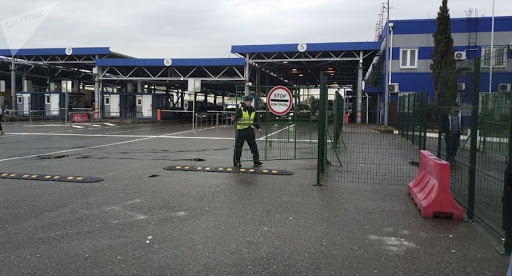
At the border there exists a burden that prevents the country from developing — and prevents those who want, despite everything, to do something useful for the country from doing so. Construction materials that are not available in our country are imported, or spare parts — and this system of state power, calling itself Abkhazian, levies on us, the people of Abkhazia, a 13.5% tax so that we can build something here. And we are also expected to feed this system.
This is to say nothing of bribery, which has long since become the norm in our country. A state that lives for itself and not for its citizens — this is the "independent republic" that has been built for us over thirty years. Within this system, the authorities, the police, the State Security Service, and the bribe-takers sit one on top of another — and all of them together sit on the neck of the people.
Has the State Security Service caught a single spy over all this far-too-long time? No — they have caught no one, and no one here will catch anyone. If they were genuinely concerned with state security, they would have to start catching each other. But that is not their task. A pity.
A crime is committed — the criminal has a name, a surname, and an address, but no one goes to his address to find him. The police imitate their law enforcement functions out on the street. Go and arrest the criminal at home! But no — they would rather catch other "criminals" — residents of the Gali district, for example. In our Gali district, residents have no passports. A peasant from Gali travels to sell tangerines — and the full force of our law enforcement system, otherwise doing nothing, descends on him: "Where did you get these tangerines — show us a document proving they belong to you." Where would he get such a document? He doesn't even have a passport. That is how his native state has looked after him — and now it will look after him a second time, by issuing him a fine.
That is what crime-fighting looks like in our country. The ordinary people's dependence on an authority that is itself independent of laws and common sense is everywhere: a handful of swindlers calling themselves authorities have been robbing the population and the country for more than a decade now. Even Aslan Bzhania — having criticized Raul Khajimba while in opposition and come to power — has only reinforced the system that existed under Khajimba. And on top of all this, he is now proposing to "improve" our laws by bringing them into line with Russian legislation. This — when the Russian Federation has in recent years adopted a multitude of, to put it mildly, strange laws that contradict both democratic principles and common sense.
With Russia, we need to negotiate not on the alignment of our legislation, but on genuine mutual cooperation — on removing the customs barriers that exist at the border, on investment in the economy. As a truly independent country, Abkhazia could have become a five-star resort for the Russian Federation — not a poor frontier post on the border with NATO, equipped with someone else's laws. If we are to have Russian Federation laws here rather than our own, then let Putin and Medvedev come here to fight NATO troops on the border — and they can take Bzhania with them, since he already fled to Russia during the war once. Let them fight, having brought Abkhazia's laws into conformity with Russia's.
It is impossible to build a dignified country at the expense of the people. It is impossible to raise the economy without having a market. We have thirty-three managers for every working person — and all of them despise that working person, even though they live at his expense. Do we need such a quantity of varied — and corrupt — bureaucracy? No. We need a strong, professional army; we need a functioning, normal police force; we need normal laws that are actually enforced — not "this is allowed, that is not" — that is not a law. We need economists and managers in government, not former police officers and State Security Service employees: these people do not even understand how economic mechanisms function; they only know how to imprison, how to destroy, how to annihilate — which is what they have been doing for almost thirty years.
Our small country needs investment — serious capital inflows. Abkhazia has a resource called nature; it has land — the finest agricultural terrain in the subtropics, where the very best vegetables and fruit can be grown. But where do we sell them if we have no means of marketing this produce? It is impossible today to trade legally either with the Russian side or with the Georgian side — and this suits the current authorities just fine, because that is precisely how they "earn" their money. It has nothing to do with the country's development. Abkhazia's monstrous dependence on its own authorities and the whims of its strategic partner will never allow us to become a truly independent and prosperous state.
Inal Ardzinba
The text contains place names and terminology used in the self-proclaimed Republic of Abkhazia.
Opinions expressed in the publication reflect the views of the author and do not necessarily represent the position of the editorial board.
The material was prepared as part of a joint project of the Accent news agency and the non-governmental organization GRASS, implemented with the financial support of the Open Information Partnership (OIP).