
"Life Will Force It"? — What Price Does Russia, Abkhazia's "Friend" and "Partner," Demand "for Peace"?
07/12/2020 17:18:29 Conflicts
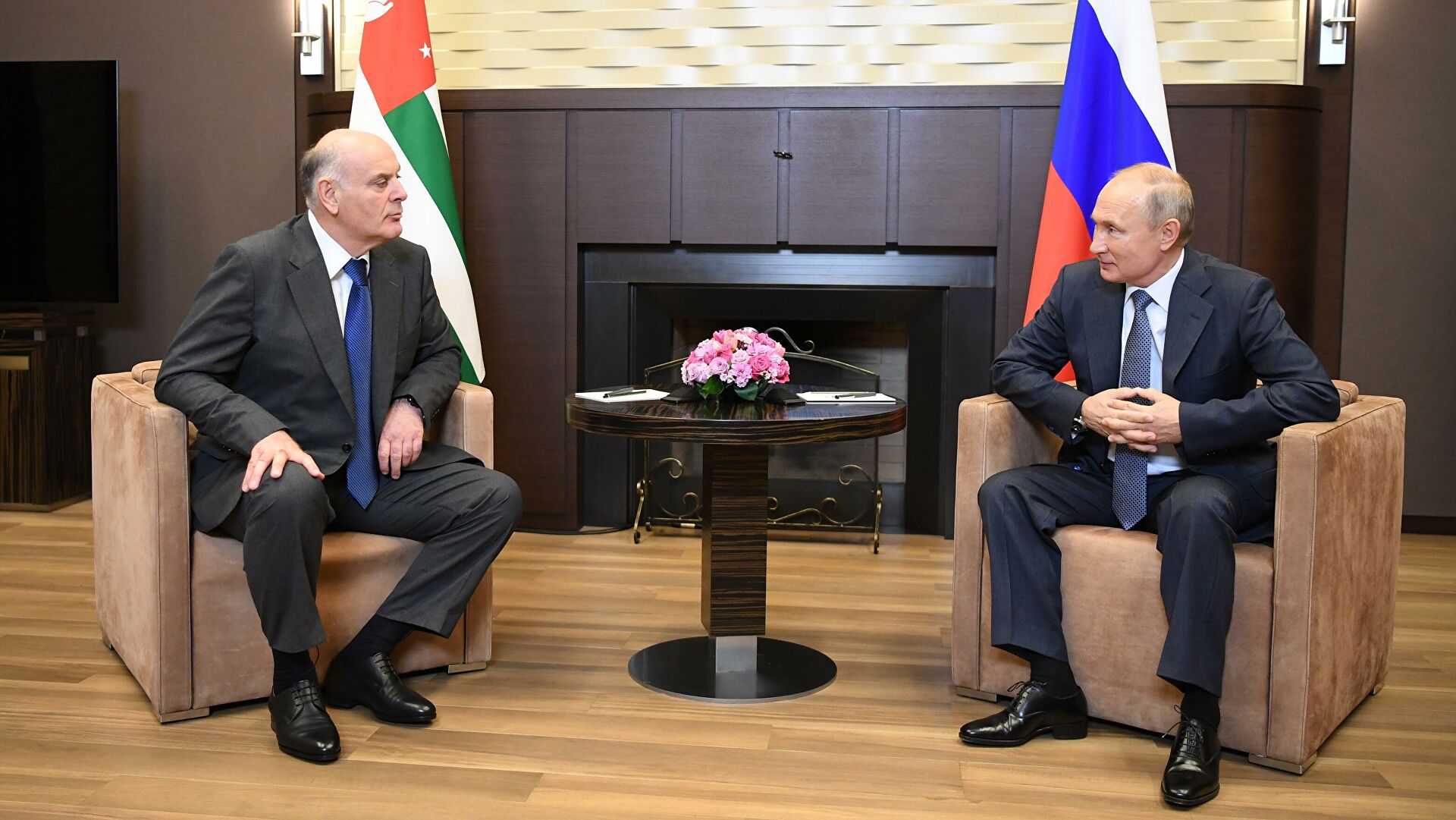
Despite the coronavirus pandemic, the absence of electricity and water, arrears owed to pensioners, queues of freight carriers at the "border," and many other problems, the center of Abkhazian public attention remains fixed on the agreement sent from Moscow — bearing an ostensibly positive name but dangerous content, like a poisonous concoction in a medicine bottle. The "Program for the Formation of a Common Social and Economic Space Based on the Harmonization of Legislation," signed on November 12th in Sochi during "President" Aslan Bzhania's meeting with Russian leader Vladimir Putin, comprises 45 points, for the implementation of which Moscow has given Abkhazia a three-year deadline. Formally, it concerns laws and regulatory acts across various spheres and areas — energy, education, healthcare, social welfare, and so on. But even to people with little knowledge of the intricacies of legislation, it is immediately apparent that the document contains serious pitfalls — and not just one — and that all of this could end badly for Abkhazia. Society — which learned of the text of the "Program" almost a year after it arrived from Moscow (it was sent in December 2019) and less than two weeks after it was signed — is seething, bewildered, and outraged. There are countless questions, and clear answers — none.
The greatest number of questions among most commentators are prompted by the provisions of the "Program" relating to dual citizenship, changes to energy legislation, and several others. "I don't know about others, but I cannot shake the feeling of a failing student whose teacher, weary of his charge's hopeless stupidity, has decided to write the test for him. And this kind of favor seems to me to be a disservice — especially since the teacher is pursuing not the student's interests, but his own," writes Abkhazian blogger Izida Chania, who considers Moscow's proposals "harmonization" for the benefit of the Russian business community. She was prompted to this conclusion in part by the amendments to the energy law envisaged in the "Program": "Since Abkhazian legislation prohibits the privatization of energy facilities with a capacity exceeding 5 megawatts, Russian officials are insisting on amendments to the law in order to make the privatization and construction of hydroelectric power stations possible." Or, for example, the question of Abkhazian citizenship for Russians: "Why would they need Abkhazian citizenship, with which you cannot travel beyond Russia? Only to acquire real estate in Abkhazia." And why Abkhazia resists this is well known to all. "After the law is adopted, citizens of the Russian Federation will be choosing the president of Abkhazia, and real estate prices will soar to the point where current citizens of the country will be unable to resolve their housing problems," Chania believes.
Her doubts about the real objectives of these initiatives from the "strategic friend" are shared by former "parliamentary" deputy Akhra Bzhania. "The adoption of any provision on dual citizenship increases the burden on our already fragile demographic situation. And besides, there are no obstacles whatsoever to the economic, commercial, or any other activities of representatives of countries friendly to us — and I see no point in endless pedaling of this issue, especially at such a level," says Bzhania. He cites the legislation of other countries, including European ones with their liberal economies, where the aforementioned prohibitions are also in force: "Transmission networks are a strategic resource and must remain solely in state ownership, so that at the critical moment the state retains full control over them."
Furthermore, in his view, the document contains "entirely incomprehensible" points relating to purely internal regulation — on the importation of mining equipment, on regulating the relationship between energy supply organizations and consumers, on establishing a justified tariff, and so on. "What will be left in the hands of the Abkhazian side then? How can an international document descend to such instructions? This is not consistent with the level of an interstate dialogue," Bzhania concludes.
Liana Kvarcheliya, member of the board of directors of one of Abkhazia's oldest non-governmental organizations — the Centre for Humanitarian Programs — has serious objections to the provision on regulating the activities of civic organizations along Russian — discriminatory — lines. She considers the corresponding Moscow demand "interference in internal affairs," fraught with extremely unpleasant consequences: "This is not only a narrowing of the space for freedoms — it is also a signal to the entire world (which has not yet recognized us, but sees the difference between Abkhazia and certain other countries where NGOs operate under unfavorable conditions) that Abkhazia is closing itself off." Moreover, in Kvarcheliya's view, the adoption of Russia's proposals will also affect the prospects for Abkhazia's further international recognition: "By doing this we would be signaling to the international community that we are in principle uninterested in contacts with the outside world — and when you demonstrate such disinterest, what incentive is there for others to regard you as a subject?"
The "harmonization" is also causing serious concern among Abkhazian business representatives, who had protested not long ago over a 10% VAT. Local businesspeople fear that the "harmonization" of tax legislation will strangle Abkhazian business altogether, as it will be unable to compete with Russian business in the face of tax increases — including VAT rising to 20%.
In the "Measures" section of the document, the "harmonizing" steps are tied to the "Treaty on Alliance and Strategic Partnership" of 2014. But the reason for this is not clear to many. It is not clear to Akhra Bzhania either: "Not one of the articles of that Treaty contains anything on dual citizenship, migration policy, energy questions, cryptocurrency mining, or the regulation of non-governmental organizations' activities. The Treaty speaks of bringing positions and legislation closer together on a number of issues in order to make customs, investment, and taxation activities more transparent, simpler, and more effective. But when I read this document, I see nothing but a set of instructions that must be rigidly implemented — with no 'bringing closer together,' no 'harmonization,' as stated in the document."
The document also raises a mass of questions among Abkhazian internet users. Many of them cannot understand why Abkhazia's legislation should be changed "at the dictation of another state — especially at Russia's demand, if Russia is truly a friend, protector, and partner." "No one objects to Abkhazia bringing our legislative framework into order — on the contrary, it is long overdue! But what does Russia have to do with it? Why should it participate in this, and moreover dictate what to adopt, when, and in what form? Why, in order to adopt the laws we need, must we sign some Russian-Abkhazian program?!" asks one of them.
Thus, the inconsistency of the document sent from Moscow with Abkhazia's interests is apparent to a great many people. But "President" Bzhania, under critical pressure from Moscow, has apparently already surrendered his position. A couple of weeks ago he was still trying to argue that the "Program" signed on November 12th derives from the 2014 Treaty — but now he has begun openly declaring that accepting Moscow's demands is "the price for peace," and for added persuasiveness is frightening the population with "military threats" that, as Bzhania claims, have become more apparent following the recent war in Nagorno-Karabakh. "Given that we have no peace treaty, and that Georgia still considers Abkhazia its territory, with a significant number of states sharing this view, the issue of military security moves to the fore," declared the "president" on December 3rd at a meeting with members of the Public Chamber, pointing to the dire state of Abkhazia's armed forces and persuading those present that without Russia they could not withstand the challenges: "Yesterday I visited our military units and I honestly don't know what words to use to describe what I saw. Strengthening our alliance — above all our military alliance — and creating a single territorial defense and security space is becoming a priority. Peace will have to be paid for; this peace must be maintained; and maintaining an armed person is not a cheap undertaking."
At the same time, Aslan Bzhania confirmed his intentions to "attract" Russian investment in the energy sector, declaring that the issue cannot be resolved without Russia and employing the phrase "life will force it": "The system has deteriorated to such an extent that approximately 10 billion rubles would be needed to revive it, and there is no one to turn to for help except Russia. Without a Russian investor, there is no way to develop the economy or have electricity in homes. When we stand before the choice of having electricity or not, having electricity that costs a certain amount of money and so on, our choice will be easier — life will force it. The time will come when we need to look the truth in the face, and we must be prepared for that."
At the December 3rd meeting, it also emerged that while the question of selling real estate to foreign — Russian — citizens had disappeared from the "Program," it has by no means been removed from the agenda. As the "president" maintains, without Russian investment in the real estate sector, the homeland cannot survive either: "Approximately 2,500 people are on the waiting list for housing — providing for them would require around 6 billion rubles. The government does not have such funds, so a pragmatic approach is needed on the question of real estate sales."
And the conclusion: without specifying how Abkhazia reached this situation, and having completely forgotten about the alternatives he had been discussing only recently — including, in particular, considering the possibility of dialogue and cooperation with Georgia — Aslan Bzhania declared "the necessity of rapprochement with the Russian Federation and participation in integration processes in the post-Soviet space," namely accession to some kind of new Union State: "Vladimir Vladimirovich, at our meeting, said that the situation on the Eurasian continent and in the world in general is developing in such a way that 'we need special relations with Belarus, with the Abkhazians, with those who consider us close.' Global processes will take place, and apparently a group of states in the post-Soviet space, if it serves the interests of their peoples, will organize some kind of union. And we, if our population does not object, will think about this."
At present, the "Program" as dictated by the "strategic friend" is being handled by the "Commission for Constitutional Reform" established on October 10th by presidential decree.
"One would like to think that within the Abkhazian working group — which has been created for the Russian-Abkhazian 'harmonization' and has begun its work — there will be people who will defend state interests. If not, there is no point in imitating statehood. It would be better to announce accession to Russia — at least then they won't be sending us 'old rakes' anymore," concludes Abkhazian blogger Izida Chania.
Yet if one thinks carefully about what has already been announced, this is in essence nothing other than Abkhazia's accession to — or more precisely, its absorption into — Russia. Or, if you prefer, annexation.
"For accession to some kind of new union, it is necessary at a minimum for the countries constituting that union — in this case, for example, Belarus — to at least formally recognize Abkhazia's independence and express a desire to admit it into their ranks. Russia, as is well known, has for many years attempted to achieve this from Minsk and a number of other countries — without success. And it is unlikely that anything will change in this regard now," believes Paata Gaprindashvili, Director of the Georgian Reform Association (GRASS). In his view, the scenario announced by the Sukhumi authorities more closely resembles smoke and mirrors — an attempt to divert the population's attention from serious problems toward some illusory vision of the future.
In reality, Gaprindashvili is convinced, what is being discussed is the assimilation of Abkhazia into Russia — and the 2014 treaty, and especially the "Program for the Formation of a Common Social and Economic Space Based on the Harmonization of Legislation," are precisely Moscow's instruments for achieving this.
Gvantsa Pipia
The material was prepared as part of a joint project of the Accent news agency and the non-governmental organization GRASS, implemented with the financial support of the Open Information Partnership (OIP).