
NATO for Sukhumi and Tskhinvali: A Real Threat, or a Kremlin Scarecrow?
28/11/2020 16:16:49 Conflicts
In fairness, it must be noted that similar concerns exist among a certain — thankfully small — portion of the residents of the territory under Georgian government control. And these concerns rest on one single foundation: Russian disinformation propaganda, actively disseminated both by Moscow itself and by certain Georgian political forces — including the Alliance of Patriots, now widely known in Abkhazia following a recent scandal — media outlets, and certain civic and other figures who are, one way or another, controlled by the Kremlin. Their main narratives are: "Georgia's cooperation with NATO may provoke new military aggression from Russia, while the alliance is no guarantor of Georgia's security"; "The price of Georgia's accession to NATO is the renunciation of its breakaway territories"; and so on. Another favorite narrative of anti-Western propagandists, working in the Kremlin's interest to slow the country's Euro-Atlantic integration, runs as follows: "By renouncing Euro-Atlantic integration — as Moscow constantly insists — Georgia would be able to normalize its relationship with Russia, which in turn would create the possibility of restoring the country's territorial integrity."
The result is an interesting picture to which I would like to draw the particular attention of our Abkhazian readers: while pro-Russian anti-Western propagandists present the course of NATO integration to Georgians as practically the main factor hindering the restoration of the country's territorial integrity, to Abkhazians they suggest the exact opposite — that it is precisely Georgia's accession to NATO that would create a danger of losing their "independence." I think it is not difficult to guess that both of these mutually exclusive claims are simply false narratives, and they serve one and the same purpose: preventing the influence of anyone else in territories that Moscow considers its own sphere of influence.
Russia has long since stopped concealing this goal. Having pretended to be as much a "friend" to Tbilisi as it has been since the 1990s to Sukhumi and Tskhinvali, the Kremlin tore off this mask the moment Georgia — having decided, in light of Moscow's own actions, to diversify its political, economic, trade, and other ties — turned its gaze toward the West. And incidentally, in the well-known events of 2008, at least one of Moscow's main objectives was precisely the same. Evidence that the Kremlin's own interests were among the leading causes of the war at the end of which Sukhumi and Tskhinvali received their Kremlin-style "independence" is abundant. Independent experts studied, proved, clearly set out, and published all of this long ago. For those who do not feel like reading analytical articles, I suggest listening to a brief but quite clear explanation of Moscow's main objective in 2008 — from Dmitry Medvedev himself, who, even if only formally, signed the relevant decrees at the time: "If we had wavered back then — in 2008 — the geopolitical arrangement would already be different, and a whole series of countries that they were trying to drag practically artificially into the North Atlantic Alliance would most likely already be there."
Twelve years have passed since then. Georgia has not yet joined the North Atlantic Alliance, but continues on the path of rapprochement with NATO. And Moscow continues to do everything in its power to prevent this, making no secret of its interest in being the "master" of the South Caucasus — without sharing it with anyone. Russian representatives continue to pressure official Tbilisi, while simultaneously convincing the population of Georgia that "NATO will not go to war with anyone for the interests of Tbilisi" — and at the same time frightening Sukhumi and Tskhinvali with the false narrative that "the North Atlantic Alliance is needed by Georgia to attack Abkhazia and South Ossetia with the aim of forcibly incorporating them."
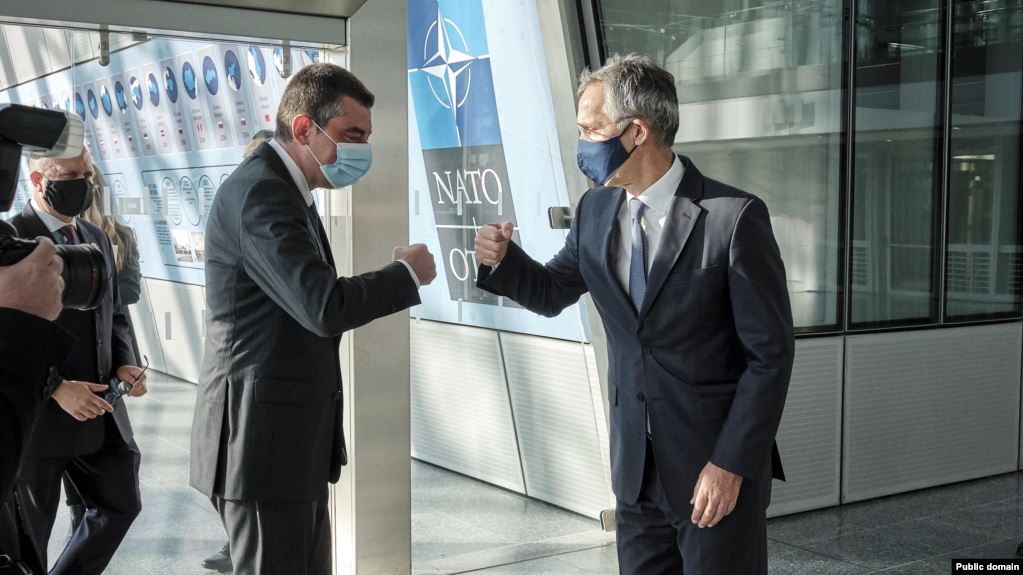
Of course, in reality things are entirely different. Refuting the Kremlin's narratives, NATO's Special Representative for the Caucasus and Central Asia James Appathurai draws attention to the fact that Georgia — which actively participates in the Geneva International Discussions — has unilaterally committed not to use force to resolve territorial conflicts, while Russia to this day refuses to make a commitment not to use force against Georgia.
"NATO respects the principle of territorial integrity, sovereignty, and independence of Georgia within its internationally recognized borders. Alliance representatives have stated on multiple occasions that Georgia deserves respect and every commendation for its patience and commitment to the obligations it has undertaken in Geneva," says James Appathurai. According to him, Georgia's course of rapprochement with NATO means that the country is strengthening its democratic institutions and the rule of law alongside the modernization of its security sector. The aim of all this is for the country to become, on the one hand, more developed, and at the same time more responsible. "Therefore, residents of Abkhazia and South Ossetia should perceive the emergence of Georgia as a modern European democracy not as a danger, but on the contrary, as a positive development creating hope for a better future," Appathurai explains.
On the question of what Georgia's real interest in rapprochement with NATO consists of, and who this could "threaten" and how, we also spoke with one of the leaders of European Georgia, Sergi Kapanadze.
S.K.: For Georgia, NATO membership is first and foremost a question of values: a democratic state integrated into Western institutions is the project for our country's future. This is what the majority of our population believes in, and this is by no means accidental — for this is our identity.
Moreover, Russia's attitude toward all countries that have joined NATO has become considerably more restrained: Moscow's desire to invade those states, seize them, and interfere in their internal affairs has disappeared. This is what drives Georgia's aspiration toward NATO — not questions of restoring territorial integrity, some militarist plans, or anything of that sort.
When we constantly reiterate that our rapprochement and subsequent integration into the North Atlantic Alliance is not directed against anyone, we mean that neither Georgia nor NATO intends, for instance, to attack anyone — including for the purpose of restoring territorial integrity. Using the alliance for such ends is not Tbilisi's objective, and moreover, it is simply impossible.
— And yet, every time Georgia's cooperation with the North Atlantic Alliance arises, we hear protest statements from Russia, Tskhinvali, and Sukhumi. Are their concerns well-founded?
S.K.: They are entirely without foundation. First, no military exercise of this kind has ever had an offensive character — it is not a "flexing of muscles" but a demonstration of cooperation. Second, in reality, everyone — including Moscow — understands perfectly well that NATO has no intention of entering into conflict with Russia. On the contrary. And the joint exercises mentioned above are conducted precisely to enhance Georgia's defensive capability.
The protest statements from Russia, Sukhumi, and Tskhinvali are part of Kremlin propaganda — a long-standing Russian doctrine: the population's attention is redirected from internal problems to an artificially constructed image of an external enemy, in the hope of justifying the absence of democracy, the absence of development, and all other existing problems — both in Russia and in Abkhazia and the Tskhinvali region — by a "constant threat emanating from the West: NATO, the United States, the European Union." And unfortunately, the residents of these regions are subjected to such influence systematically.
— The North Atlantic Alliance usually does not admit countries with territorial conflicts into its ranks. However, there is the precedent of Germany, which in its time joined NATO "in parts" — as the GDR and FRG. Let us imagine that Georgia were admitted to the alliance on the German model — temporarily not extending Article 5 of the NATO charter to Abkhazia and the Tskhinvali region. What would this change for Sukhumi and Tskhinvali, which, as is well known, are attempting with Moscow's help to achieve broad international recognition? Would Georgia's accession to NATO automatically create a threat to their "independence"?
S.K.: The temporary non-application of Article 5 of the NATO charter would mean that Georgia would join the alliance and its territorial integrity would continue to be recognized by the international community — but the alliance would make a caveat that it does not intend to treat Russia's occupation of Abkhazia and the Tskhinvali region as an attack on Georgia, and therefore would not use force to liberate these territories from Russian occupation, continuing instead to seek the peaceful resolution of the conflicts. Article 5 would accordingly be temporarily applied only to the territories under Tbilisi's control.
— We say "temporarily." Under what conditions and on what terms would Article 5 of the North Atlantic Alliance charter subsequently be extended to Abkhazia and the Tskhinvali region?
S.K.: Only after the conflicts have been resolved — and precisely by peaceful means — would NATO be able to extend its protection, that is the application of Article 5, to the entire territory of Georgia. Though even then, various caveats and certain transitional, temporary arrangements would be possible.
So in any case, NATO poses no danger to either Sukhumi or Tskhinvali. At present, the real dangers for them are being created precisely by Russia.
Ekaterine Tsanava
The material was prepared as part of a joint project of the Accent news agency and the non-governmental organization GRASS, implemented with the financial support of the Embassy of the Czech Republic in Georgia.