
"Russia Is Not Only Trying by Every Means to Seize Abkhazia's Energy Sector in Its Entirety, Including the Inguri HPP, but Also to Make Large Sums of Money from It"
28/11/2020 15:00:56 Conflicts
Over the past two months, Abkhazia has been plunged into darkness for six hours a day — four hours during the day and two at night; somewhat later, for four hours only; and now for just two. Most of these power outages, unprecedented in their own way since the end of the war, fell during working hours. During these periods, life in the republic came to a complete standstill, as not a single institution — public or private — was functioning.
The introduction of rolling power cuts — the schedule for which was set by the company Chernomoryenergo and approved by Abkhazia's Ministry of Economy — was presented to the population as a forced measure. All explanations came down to the dire situation in the energy sector, catastrophically deteriorated networks, and crypto miners illegally consuming millions of kilowatt-hours. Notably, this year — for the first time in five years — the authorities made no mention of the critically low water level in the Jvari reservoir of the Inguri HPP, which had previously plunged Abkhazia into darkness on multiple occasions. Not surprisingly — the autumn had been a rainy one, and that particular myth could have been debunked at a moment's notice.
This time, energy workers were beating their breasts over mistakes made and opportunities missed throughout all the preceding years to correct the situation. And to cap it all, illegal cryptocurrency mining arrived on the scene — officially banned in Abkhazia, but at the same time not subject to any particular oversight.
"According to State Customs Committee data, from 2016 to the present day, 64,632 units of cryptocurrency mining equipment have been imported into Abkhazia. Of these, 43,414 units were brought in during the nine months of 2020," wrote former customs official Tengiz Djopua on his Facebook page. According to his information, throughout these nine ill-fated months, this equipment had been feverishly imported into the country — entire farms based on 40-foot containers, with 550 machines in each. "In a single day, while the country was convulsed by political and epidemiological upheaval, up to a dozen containers were crossing the border. I don't think the political disagreements got in the way of importing this much equipment during those nine months — more equipment, in fact, than the country has electricity to power," wrote Djopua.
According to official data from Abkhazia's customs committee, indeed more than 80 million rubles' worth of cryptocurrency mining equipment was imported into the republic during 2019 and the first half of 2020. However, the state body said not a single word about who all this equipment belongs to. So it turns out that the activity itself has been banned, but the importation of equipment for conducting that very activity has not. A paradox, is it not?
"The analysis of measures taken by the authorities to combat illegal cryptocurrency mining in the country is insufficiently effective, half-hearted, and purely declaratory in nature," stated the party Aynar, sharply criticizing Abkhazia's leadership for its incoherent attempts to bring order to the sphere of illegal electricity consumption by cryptocurrency miners.
The opposition civic organization Aruaa shared this view, with its leader Temur Gulia stating that "using our common energy system for a cryptocurrency mining business is inadmissible."
But is it right to place all the blame for Abkhazia's electricity supply problems exclusively on the miners? Few in the republic see the need to address this question, preferring to turn the cryptocurrency miners into some kind of all-purpose mystical bogeymen.
Practically every successive Abkhazian government has spoken of the impending collapse of the energy sector — yet each time, without taking any action, it preferred to defer the resolution of the matter to better times, apparently hoping the situation would somehow resolve itself. It did not. What is more, the collapse has now deepened to the point where the question of existence itself faces Abkhazia's national energy sector. Time and again, the pile of deferred problems has come crashing down on the heads of the republic's population, and behind it the risk of losing the national energy system is absolutely evident. For the first time, Abkhazia has begun openly speaking of the possibility of selling it to Russia.
"We officially declare that any attempt by the authorities to transfer Abkhazia's generating capacity and energy networks from state ownership into private hands — under cover of an inability to resolve the problems that have arisen in the sector — will be viewed by us as the deliberate surrender of Abkhazia's national interests," stated the party Aynar.
And if previously Abkhazian society had only suspicions that someone was trying to lay hands on the country's energy system, now everything has become clear. And this mysterious entity attempting to wrest from Abkhazia one of the most important components of a fully functioning state has acquired a name — Russia.
"They spent a long time persistently drumming into our heads that there were terrible, nightmarish problems with the energy sector — sounding the alarm every time, saying something must be done! But in practice, nothing was done — so that at the right moment, our energy system could simply be handed over to the Russians. And evidently the right moment has arrived. You may consider that we have already been left without our own energy system," says our interlocutor Daniil. According to him, the transfer of ownership of our energy sector to Russia is only a matter of time. It is not without reason, he says, that the Russians have begun speaking of the debt that Abkhazia has not repaid for the cross-border electricity supply from last year.
"The Russians came and conducted a full inspection of our energy facilities. What for? Does anyone seriously believe it was just out of the goodness of their hearts? Absolutely not! They were studying the condition of what they will very soon have in their hands — something they have desired for a long time," believes our interlocutor Madina.
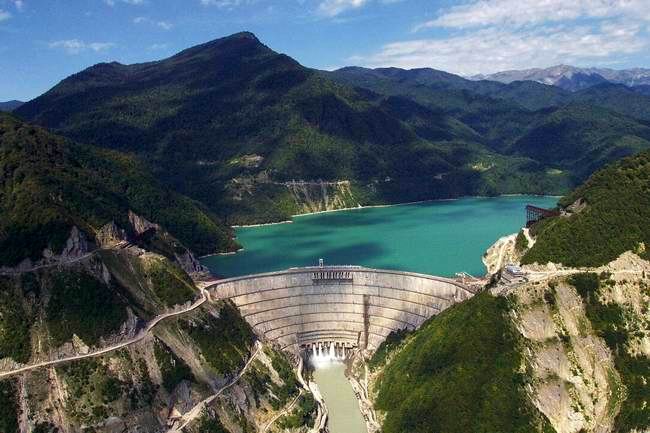
Another interlocutor, Alexei, believes that Russia is not only trying by every means to seize Abkhazia's energy sector in its entirety — including the Inguri HPP — but also to make large sums of money from it. "The fact that Georgia pays Russia for electricity supplied to Abkhazia is no secret. Remember the story of Inter RAO. So it turns out that Georgia pays Russia money for this, and Russia then gifts that same money back to us Abkhazians — supposedly through the Investment Program. We also pay Russia money for electricity — every year the authorities tell us that 800 million rubles have been paid to Russia for power. So Russia gets a double benefit," Alexei reasons.
I tried to investigate and search for the necessary information about payments for electricity supplied to Abkhazia on the official government websites of Russia, Georgia, and Abkhazia. However, I was unable to find this information — and not because I searched badly or in the wrong places. No such information is publicly available, which colleagues in Georgia also confirm. What is more, not a single word about payment for electricity cross-border supply appears in official Abkhazian documents either. One way or another, the republic's population has more than once raised the question of who actually pays for the privilege of living with a constant electricity supply — a question that has stubbornly been ignored to this day. And then, right on cue, information appeared on the Ministry of Economy's website stating that from December 1st, Russia may supply cross-border electricity to Abkhazia.
"The price Abkhazia will pay for every kilowatt of electricity is several times higher than the rate established within the republic. In this way, certain individuals and groups of people will profit by exploiting state energy capacities and creating corruption schemes, while Abkhazia will purchase electricity from Russia at the expense of the state budget. All of this could lead our country into an extremely dire situation and once again saddle us all with unbearable debts," declared the opposition in response to the announcement.
And the population has once again grown anxious about the consequences of Russia's "assistance." We all have the right to know who is actually paying Russia for the electricity supplied to Abkhazia. And at the same time, we would like to hear the truth about whose pockets the millions of rubles were paid into — written off from the Abkhazian budget as payment for electricity that Georgia had already paid Russia for.
It does not matter who ultimately reveals this secret — Georgia or our own Abkhazian authorities — since Russia is hardly likely to make any admissions that are not in its interest.
Kristina Avidzba
The text contains place names and terminology used in the self-proclaimed Republic of Abkhazia. Opinions expressed in the publication reflect the views of the author and do not necessarily represent the position of the editorial board.