
The New Russian-Abkhazian Reality: The Karabakh War Is Over — Fear the Peace?
24/11/2020 08:45:54 Conflicts
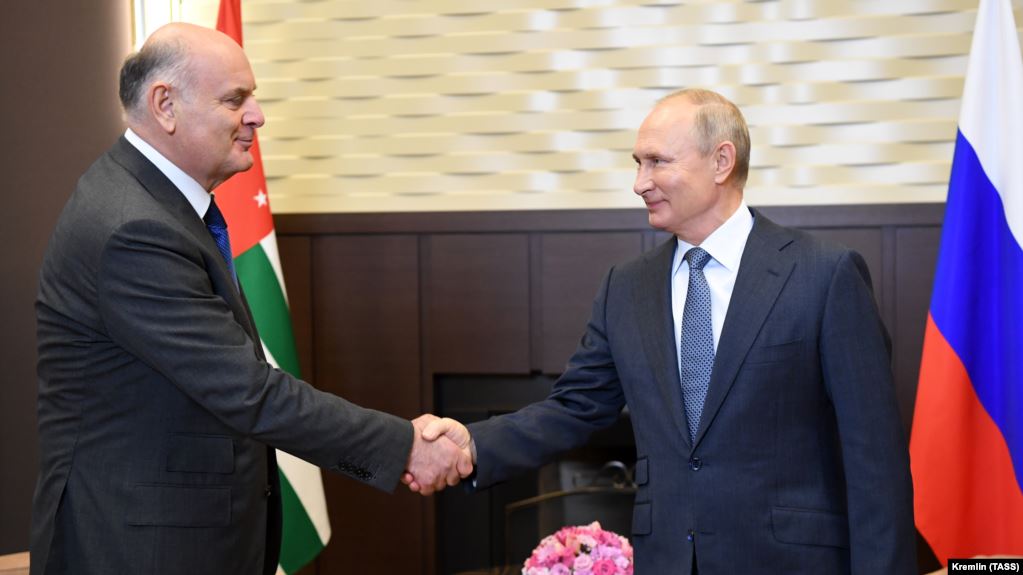
At a recent press conference following his meeting with Russian President Vladimir Putin, Abkhazia's "president" Aslan Bzhania informed his compatriots that the events in Karabakh "have changed and will change a great deal." This is hard to disagree with: only a few days have passed since the signing on November 10th of the tripartite agreement — between Azerbaijan, Armenia, and Russia — on the cessation of hostilities, and the South Caucasus is already different. Judging by a whole series of statements from both Russian and now Abkhazian officials, Abkhazia will be no exception to this — and the well-known wisdom "the war is over — fear the peace" is becoming extremely pertinent for it.
It is entirely against my interests to frighten, sow panic, drive into depression, or provoke aggression toward anyone — and from a moral standpoint, to do so toward Abkhazia's residents, who already find themselves in a difficult enough position, would be unforgivable. After all, the cessation of Russian financial assistance, the closure of the "border," the prolonged medical blockade at the height of the pandemic imposed by the "strategic partner," and much else that our Abkhazian readers know better than we do — these provide more than sufficient grounds for crisis and pessimism. The trouble is that there is unfortunately nothing with which to lift their spirits: the new reality appears to hold nothing good in store for Abkhazia.
And the danger here comes not from the direction that Moscow points the population of Abkhazia toward: Tbilisi, which to this day has been putting forward various peace initiatives and has no intention of attacking anyone, is at this moment occupied with the pandemic, as well as with parliamentary elections, while simultaneously trying to make sense of what the 44-day second Karabakh war has changed for it, what to expect in this new reality, and how to meet the new challenges in order to defend itself and its interests.
When I speak of the new reality, I have in mind above all the fact that thanks to the "great victory in the Karabakh war by Russia and personally President Putin" — which Russian propaganda has been working with all its might to convince everyone of since the end of hostilities — for the first time in 224 years (since 1796, when Russia began actively interfering in the affairs of the South Caucasus and sending troops to the region), a Russian ruler has agreed to the appearance in Transcaucasia of such a player as Turkey. This was agreed upon by Presidents Putin and Aliyev before the signing of the tripartite peace agreement — and although Sergei Lavrov, Maria Zakharova, and other Russian representatives subsequently tried in every way to obscure this fact, Putin himself never once denied the agreement on a joint Russian-Turkish peacekeeping mission, nor could he have denied it, given the video recording of that conversation distributed by the Azerbaijani side.
The result is that the South Caucasus now hosts the converging — and in some respects overlapping, in others directly opposed — interests of two major players: Russia and Turkey. And as many experts believe, this may to one degree or another affect Abkhazia as well.
Given that Turkey also has its own levers of pressure on Sukhumi — both the Abkhazian diaspora in Turkey and the fact that Turkey is Sukhumi's second-largest economic partner after Russia — the Kremlin apparently decided to act preemptively. Everything that until recently had been voiced from Moscow in the form of private ideas from obscure politicians and various marginal figures, and later as hints from official representatives, has now begun to be pushed through forcefully at the official level: summing up at a press conference in Sukhumi on November 17th the Sochi meeting with President Putin, Aslan Bzhania made a series of statements that left the journalists present in a state of shock.
Thus, the passions in Abkhazia surrounding the effective seizure of the village of Aibga by the "strategic friend" had barely subsided when the word "referendum" was uttered at Bzhania's final press conference — and this was said not by Accent (which has been consistently warning in its articles about the approaching danger and accused for this by various Abkhazian pseudo-"patriots" and numerous Kremlin social media "trolls" of engaging in "Georgian disinformation propaganda"), not by experts expressing personal opinions, not by individual Russian marginals and obscure politicians — but by "President" Bzhania himself.
Based on what he said at that press conference, the "strategic partnership" with Russia holds the following in store for Abkhazia in the short term — and this is only a brief list of the main items Moscow has demanded that Sukhumi fulfill:
- The lifting of the ban on foreign investment (in reality, the privatization of energy infrastructure assets) in Abkhazia's energy sector. At the press conference, "President" Bzhania stated that this ban "does not allow investment to restore energy facilities," that "investment in the energy sector is necessary," and that Putin "promised to help and expressed a desire for this question to be resolved once and for all."
- Consent to railway transit through Abkhazia to Armenia. Bzhania did not reject this possibility and stated that "transit is possible under favorable conditions, which depend on how events around Nagorno-Karabakh develop."
- The lifting of the ban on the sale of land and other real estate to foreigners — that is, to Russians — something Abkhazia has been resisting with its last strength for years.
- The integration of Abkhazia into the so-called Union State of Russia and Belarus. "And what, in your opinion, is the creation of a common defense and security space? And the creation of a common social and economic space? It is the unification of rules. And what does creating conditions for Abkhazia's full participation in post-Soviet integration processes implemented by the Russian Federation mean? You have probably heard that the union of Russia and Belarus is spoken of very frequently," Bzhania told journalists on this matter, and apparently sensing the coming storm, called in advance on the population to "value and cherish the enormous assistance provided by Russia."
Speaking of all of this, he explained that "there are questions that will be resolved at the government level, some at the government and parliament level, and some by the population" — and added that "thank God, there is such a mechanism as a referendum, and it can be used not only for domestic political matters, but also for resolving more global questions."
What all of the above will ultimately mean for Abkhazia, I think, requires no explanation — at least for most of our readers. And for the event that someone in Abkhazia "dares" to express disagreement, the "strategic partner" has sufficient forces on the ground to transform that disagreement not only into agreement, but into "the most humble request of the Abkhazian citizens themselves."
For now, the Kremlin is attempting to achieve its aims by "peaceful means" — through disinformation propaganda. This is coordinated by the Russian "embassy" in Abkhazia and carried out by various Russian organizations whose employees have begun distributing what amount to genuine proclamations among the population. The authors of these texts claim that the Karabakh war — or rather its outcome — has allegedly prompted Tbilisi to "implement its revanchist plans, and new aggression from the Georgian side should now be expected." Simultaneously, the proclamation authors are frightening the population with claims that a coup is supposedly being prepared in Russia, that for some reason Communists will come to power, and will on the very next day annex Abkhazia to the Adler district of the Krasnodar region of the Russian Federation — "without any status whatsoever." And therefore, they assure the public, Abkhazia "must urgently join the Russian Federation on its own initiative — since in that case it would be possible to preserve at least some status."
Meanwhile, in Armenia — where the alliance with Russia has brought a crushing defeat in the war, with all its dramatic consequences — as in Karabakh, the desire to have anything to do with Russia has permanently faded for many. For: 1) The much-vaunted Russian weaponry — including anti-aircraft systems, the same notorious S-300s, Tor, Osa-AK, and others — purchased by Armenia from Russia, which was considered its partner, proved completely ineffective in combat and was entirely destroyed by modern drones acquired by Azerbaijan from Turkey and Israel. These are not my assessments — this is a fact acknowledged both by experts and by Armenian Prime Minister Nikol Pashinyan himself, who recently reported to deputies of the Armenian parliament; 2) Military training, as well as strategic and tactical doctrine — to which Armenian military personnel were trained according to Russian schemes and in Russian military academies — likewise proved completely unsuitable and suffered total collapse; 3) Having assessed how their "ally" conducted itself before, during, and after the second Karabakh war, many in Armenia have come to look at Russia and "partnership" in the Kremlin's interpretation in an entirely different light.
So what lessons should Abkhazia draw from the situation in Nagorno-Karabakh? After his meeting with Putin, "President" Bzhania declares that "in the interests of ensuring the interests of the Abkhazian people, it is necessary to strengthen the allied relationship with the Russian Federation." How many Abkhazian residents will share this opinion — is for the population itself to decide.
Gvantsa Pipia
The material was prepared as part of a joint project of the Accent news agency and the non-governmental organization GRASS, implemented with the financial support of the Embassy of the Czech Republic in Georgia.