
Has Aibga Become Russian?
13/11/2020 11:40:02 Conflicts
The construction on the "border" territory along the Psou River of a pedestrian bridge connecting the Abkhazian settlement of Aibga with the Adler district of the Krasnodar region of Russia has been interpreted in Sukhumi as "a violation of the territorial integrity of Abkhazia." The leaders of the united opposition have demanded explanations from the "government," while the "parliament" is discussing the situation behind closed doors with representatives of the "Foreign Ministry" and the "State Security Service."
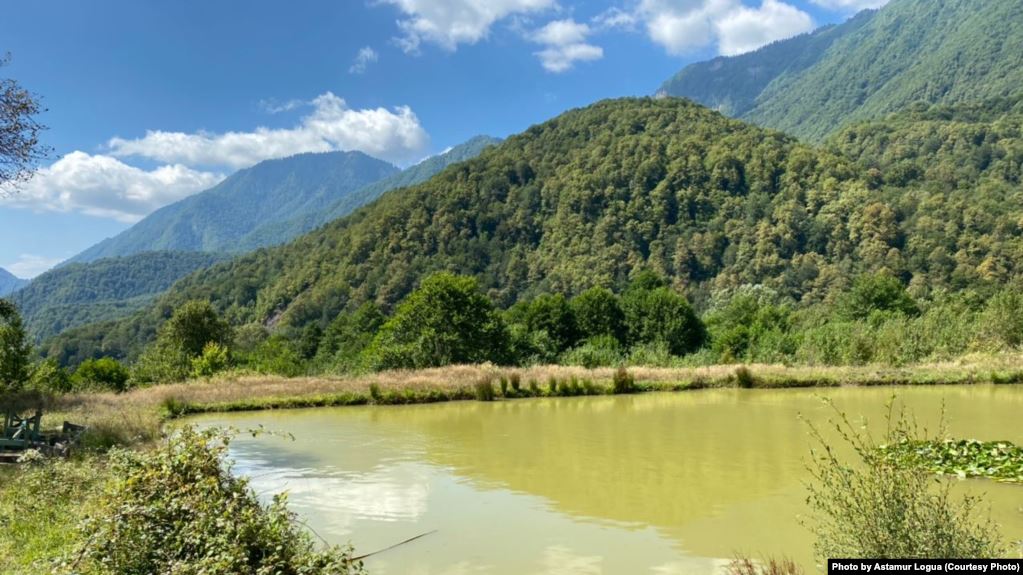
It is noteworthy that Abkhazian society learned of the existence of the new bridge from Russian media. The author of a piece in Kuban News solemnly informed readers that a new pedestrian bridge had been built in Sochi, connecting "vital social infrastructure facilities of the Nizhneshelovskoye rural district with one of the most remote settlements in Sochi," and that the suspension bridge made of iron cables and timber planking had been erected in the space of a single month. The "necessity" of constructing this "sturdy" structure was explained in the article as follows: "According to local residents, there had been no reliable bridge here for about 20 years, and to get to a shop or post office one had to travel approximately 25 kilometers each way — now that distance has been reduced to 4 kilometers." The author of the piece conveniently "forgot" to mention the fact that a genuinely sturdy concrete bridge across the Psou River already existed. And the "most remote settlement in Sochi" he referred to is in fact the high-altitude village of Aibga, located on the territory of Abkhazia.
Everything connected with the "border" Aibga is, for understandable reasons, perceived extremely acutely by Abkhazian society. The construction of this bridge was interpreted in Sukhumi as "an encroachment on the territorial integrity of Abkhazia" by Russia. Four leaders of the united opposition — Timur Gulia, chairman of the veterans' organization Aruaa; Aslan Bartsits, head of the political party Forum of National Unity of Abkhazia; Vitaly Gabnia, chairman of the party Apsny; and Adgur Ardzinba, leader of the Abkhazian People's Movement — issued an appeal to the "authorities" asking "how legitimate the construction of this bridge in the border zone was, and how such a thing could have happened."
As one of the signatories, Timur Gulia, explains: "Any construction or installation work in border zones along the Psou River must be formally agreed between the two countries at the level of their governments — in this case, it was not. The bridge that has been built should not be there under any standards of interstate relations — which means we are dealing with a violation of the state border and the territorial integrity of Abkhazia." He also noted that there was no necessity for the bridge's construction: "We are talking about a few — around seventeen — dacha-type houses. The Russians living there, who are registered in the Adler district, grow crops, keep bees, raise livestock, and return to the Adler district. There is a concrete bridge across the Psou River that residents of this settlement cross without hindrance. On the Abkhazian side, they are met by a border post of the Republic of Abkhazia, where their documents are checked, and they proceed to their village without customs inspections." Gulia also pointed out that "the jurisdiction of the Gagra district of Abkhazia does not extend there, as there is no village head, no local police officer, no post office."
In the opposition's view, the Abkhazian "government" must initiate negotiations and determine the status of the residents of the settlement of Aibga. "We have unfortunately not yet carried out the demarcation of the state border at this location. We will need to sit down at the negotiating table and determine the status of the village's residents. The territory unambiguously belongs to Abkhazia — that is not up for discussion. Any visitor can see with the naked eye that this territory lies on the Abkhazian side, beyond the Psou River. My only concern is the status of the settlement's residents," says Timur Gulia.
The Abkhazian "parliament" recently held a session on this matter with the participation of representatives of the "State Security Service" and the "Ministry of Foreign Affairs." However, since the session was closed, the details remain unknown to the public for now.
It should be noted that the Aibga question has come up on the agenda more than once before. The most recent occasion was at the end of the summer of this year. At that time — again thanks to Russian media — first official Tbilisi, and then — after Tbilisi filed a protest (in which the Georgian Foreign Ministry stated that the process of delimiting the Georgian-Russian state border, including its Abkhazian section, would not take place under conditions of occupation) — Abkhazian society also learned that Aibga had apparently already been entered into the Russian state cadastre. At the end of August, a group of Abkhazian "deputies" made the journey up to the settlement. But then the question was, as before, "buried." This stretch of the "border" remained undemarcated, and the Abkhazian "Foreign Minister" Daur Kove assured at the time that "there are no grounds whatsoever to say that Aibga belongs to Russia." "The process of delimitation of the Abkhazian-Russian interstate border — which includes the question of the village of Aibga — is the responsibility of the joint Abkhazian-Russian commission, whose work has not yet been completed. Therefore, to say that the village of Aibga is today in Russia is incorrect — it is disinformation," Kove stated. The awkward situation with the Russian cadastre he explained thus: "The settlement of Aibga is also located on the territory of the Russian Federation, and if it features in Russian cartographic records, there is nothing surprising in that. As for the Aibga located on Abkhazian territory — it is on the territory of our country, under our jurisdiction." In the end, Abkhazian society at the time accepted the story as it was presented to them — as "traditional Georgian disinformation propaganda." But a few months passed, and the Aibga question has once again risen to the top of the agenda — this time in the context of the bridge.
And yet Aibga is but a drop in the ocean of Russia's far more ambitious objectives with regard to Abkhazia — the very same ones with which Accent has familiarized its readers on multiple occasions in recent publications, while certain Abkhazian colleagues and a number of Abkhazian political and other figures — susceptible to Kremlin influence for various reasons, sometimes purely mercenary — each time "christened" it "Georgian disinformation propaganda." Now, as Moscow has moved from words to deeds — to the practically open annexation of Abkhazia — with all the Kremlin's objectives being realized step by step before their very eyes, even these "non-believers" have sounded the alarm themselves — hopefully not too late. However, driven by their own mercenary interests, they are in reality only assisting Moscow in the realization of its designs — a part of which is the comprehensive discrediting and marginalization of the current Abkhazian "authorities." For after Bzhania's team "dared" to consider cooperating with Tbilisi in parallel with the Abkhazian-Russian strategic partnership, the Kremlin has for several months been doing everything in its power — closing the "border" before the tourist season and cutting off financial assistance; the medical blockade during the height of the pandemic; compelling Abkhazian pensioners — members of the highest-risk group — to stand in long queues; and most recently, President Putin's refusal to meet with "President" Bzhania, who has now flown to Moscow for the umpteenth time amid the crisis — to intensify popular discontent in Abkhazia toward Bzhania's team. And in doing so, Moscow is actively using both the revanchist-minded representatives of the former Abkhazian "leadership" and the political organizations that support them — such as the veterans' organization Aruaa — as well as journalists.
The latter are examining the Aibga question through the lens of Moscow's long-standing broader objective — the lifting of the prohibition currently in force in Abkhazia on the sale of land and other real estate to Russians — and it must be said that in this they are entirely correct. The only difference is that they shift the emphasis away from the frankly hostile actions of the "strategic friend and partner" and onto the "mercenary interests" of Bzhania's team, which in their version is attempting to profit from Abkhazia's unresolved problems with Russia. Yet they themselves point out that all the problems now raining down on Abkhazia's head should have been resolved over the course of 27 years — while Bzhania's team only came to "power" a few months ago, at an extremely difficult time — made so in large part, one might add, by Moscow.
"Today our parliament convened in closed session. The occasion was the actions of the Krasnodar regional authorities, who — without coordinating with the State Border Demarcation Commission — built a bridge in the Abkhazian highland village of Aibga. And this too is a problem from that same Pandora's box that has been opened by Abkhazia's authorities, who treat our country as an extension of their own private business," reads one such publication.
Whether the 46-point document on a "unified Russian-Abkhazian social and economic space" — sent from Moscow in December of last year, while Raul Khajimba's team was still in power — was discussed at that closed "parliamentary" session remains unknown. The full text of this document remains unknown to Abkhazian society to this day. As it also remained unknown, according to Accent's information, to the majority of Abkhazian "deputies" as recently as last week. But even the few points that have leaked onto social media allow one to conclude with considerable confidence that the Kremlin has in fact moved from words to deeds — and that the plan for the annexation of Abkhazia is already in motion.
Gvantsa Pipia
The text contains place names and terminology used in the self-proclaimed Republic of Abkhazia. The material was prepared as part of a joint project of the Accent news agency and the non-governmental organization GRASS, implemented with the financial support of the Embassy of the Czech Republic in Georgia.