
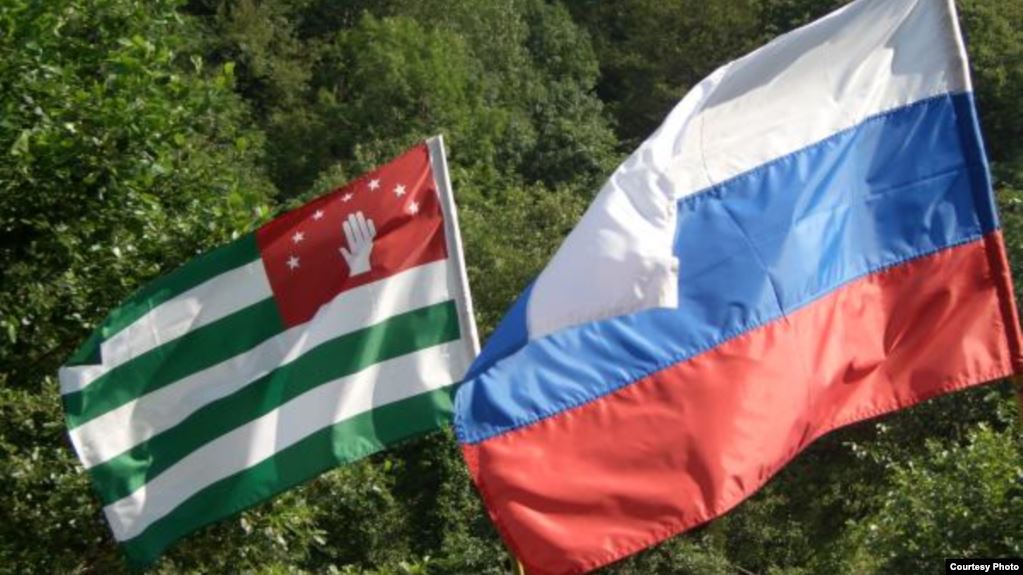
Russia — Abkhazia: "Harmonization" Without Harmony
21/10/2020 07:37:55 Conflicts
Observing what has been happening in Abkhazia recently, a well-known phrase of Voltaire's comes to mind of its own accord: "Freedom is not what you have been given, but what cannot be taken from you." But I am not going to philosophize — I will move straight to the facts.
"President" Aslan Bzhania has, by his own decree, created a working group to prepare proposals for a "program for the formation of a common social and economic space between Abkhazia and the Russian Federation." As became known first from leaks confirmed by sources in the "parliament," and later confirmed by the "president's" assistant for strategic communications Renat Karchaa, the corresponding "legislation harmonization plan" sent from Moscow at the end of last year consists of 46 points and touches on practically all the important spheres of Abkhazian society's life — including issues that are highly sensitive for it, such as the transparency of the "state" border, the lifting of the ban on selling real estate to Russian citizens, the entry of Russian investors into the Abkhazian energy system, and others.
And since even the most optimistic people in Abkhazia have stopped turning a blind eye to the increasingly intensified Kremlin pressure — the cessation of financing, the effective medical blockade during the coronavirus pandemic, the tightening of measures for pensioners, and so on — I will also count as fact that the Sukhumi leadership, caught between two fires — the Kremlin and its own people — is making decisions under enormous pressure, at risk of going down in Abkhazian history with the most unfavorable image, or even being torn apart by its own people somewhat later.
Hence, apparently, its long silence in the face of the increasingly unambiguous "partnership proposals" emanating from Moscow. First came the ideas of Prilepin, Prokhanov, Zhirinovsky, and others about the "necessary" annexation to Russia; then Zatulin's statements that "Abkhazia as a state is not passing the test of success very well"; and finally, remarks by Foreign Minister Sergei Lavrov that "the property of ethnic Russians and ethnic Georgians — Russian citizens — in Abkhazia is a matter of Russia's constant attention" and that Moscow will now "promote" these issues "more energetically."
Where, in fact, did the question of the situation and rights of Russians in Abkhazia now come from? It was raised — clearly not by accident — at a meeting with Lavrov by one of three interviewers: the editor-in-chief of Komsomolskaya Pravda, Sungorkin. And while the Sukhumi "authorities" were silent, the response to Sungorkin came from social media:
"The editor-in-chief of Komsomolskaya Pravda, Sungorkin, surprised us today with his assertions at a meeting with Lavrov about the situation of Russians in Abkhazia. He has never visited Abkhazia, and his statements more closely resemble Georgian propaganda with no connection to the truth. Regarding property disputes, including criminal cases — Abkhazians are also among the victims, not only Russians. Russians in Abkhazia are full citizens of our country, as are representatives of other peoples, with all the attendant rights. To give the problem a national coloring is a serious mistake. Furthermore — the Republic of Abkhazia has in all cases behaved toward Russia as a reliable friend and ally, unlike certain others — on Turkey, Syria, Ukraine, Armenia. And finally — in Abkhazia the Russian language is in no way suppressed; it is used on equal footing with Abkhazian; the Russian ruble is used as the state currency; Russian-language schools function; Russian-language broadcasts are present on Abkhazian television channels. And now a question for Mr. Sungorkin: is there a second country in the world where a Russian person breathes so freely? Let him answer that."
If until recently, against the backdrop of the intensifying alarming signals from Moscow, the sense of something being wrong in Abkhazian society had been growing, then now — after the "presidential" decree — it has become clear that the concerns were not unfounded, and that the Kremlin's "harmonization plan" is an "offer" that Sukhumi will find difficult to refuse. Demands began to be voiced on social media that the "authorities" discuss all issues with the people:
"Everyone wants to know: on which points, under which articles will there be changes. The [presidential] decree doesn't tell you — it's uninformative. They must tell us everything clearly and openly, and hold a public discussion, if they want this to proceed quietly."
"That reform is needed is clear, but which specific points are we talking about, and what will we — the people — ultimately be dealing with? Three points in particular cause alarm: the state border, a revision of the citizenship law, and the real estate law. All these problems must be resolved openly, not behind closed doors. Before it goes to parliament, the people must be consulted — otherwise there will be serious trouble. Because in the end, nothing can be hidden from anyone."
Having analyzed the Moscow "proposals," a whole series of "hidden reefs" were also identified by Abkhazian analysts. Focusing particular attention on several points — point 2: "repeal of the provision of the RA Law on Electric Power providing that transmission networks in the RA are state property of the RA and are not subject to privatization"; point 9: "development of a law on strategic planning"; point 11: "development of regulations enabling Russian creditor banks to recover debts under loan agreements and foreclose on collateral property in the RA"; point 14: "amendments to existing RA legislation with the aim of lifting the ban on the sale of residential real estate to Russian citizens"; points 37–40: "preparation of bilateral instruments in the field of customs regulation; development of common approaches to the forms of customs documents" — they recommended that the "Security Council" organize a discussion of the draft with the participation of "deputies," representatives of relevant agencies, the academic community, and the public "with the aim of developing a mutually agreed policy that serves the interests of national security."
The "authorities" were forced to break their silence, but limited themselves for now to attempting to present the substance of the Russian "proposals" to the population as softly and vaguely as possible, without going into details: "A common socio-economic space is when two territories, two countries, two states live by — if not identical, then at least corresponding rules of social and economic life." Among the "advantages" for the Abkhazian side, they cited "the improvement of legislation in the sphere of immunoprophylaxis of infectious diseases, pension provision, and the quality of citizens' medical care"; "maximum synchronization of customs regulation rules with the EurAsEC to facilitate the passage of Abkhazian goods across the border"; as well as "regulation of issues relating to the protection and defense of intellectual property rights, in particular of individual entrepreneurs." All of this is presented to the population as "things that should advance Abkhazia as a state governed by the rule of law." Meanwhile, no one in the "leadership" can or wishes to explain clearly why it did not move in this direction during 12 years of "independence," or why the Russian "strategic partner" decided to initiate the process precisely now. Moscow explains this simply — by the "birth trauma of the Abkhazians" — and that is that.
Under such conditions, it is difficult for the population to determine how real the "advantages" of Moscow's "proposals" are, and even if real, whether they are capable of outweighing the risks and the "disadvantages." But apart from the population itself, this complexity apparently suits everyone: Moscow pushes harder, while the Sukhumi "authorities" attribute the negative public resonance to "incorrect packaging of the questions at the start," commenting on the three issues most sensitive to society in the most "straightforward" terms: 1. "Borders can be rigid and impermeable, or they can be conditional — everything depends on the regime of relations between states, and the establishment of common rules of governance, by design, should significantly ease the crossing of the state border"; 2. "On the subject of lifting restrictions on the sale of residential real estate to Russian citizens, there is a great deal of speculation, demagoguery, and phobia — a decision must be made thoughtfully"; 3. "Concerns about Russian investors entering Abkhazia's energy market are understandable, but the market dictates its own terms — it must be brought in line with modern standards."
Moscow, for its part, appears entirely unconcerned about whether its "friendly partnership proposals" will be approved by Abkhazia's population. The Sukhumi "authorities" have been given a strict deadline: to present the final version of the "plan" no later than early spring 2021, and to implement the Kremlin's wishes from 2021 through to 2023.
For the states of the South Caucasus — and not only them — it has long been no secret: if you share a border with a country under leadership like the current Kremlin's, sooner or later you will have to deal with serious problems. Now, it appears, this bitter truth will have to be confronted by those who, thanks precisely to the decisions of the current Kremlin, once received something — naively assuming that this something was given from the heart and for good.
And here I will return to Voltaire: what he once said about freedom is apparently quite applicable to the concept of independence. And it would seem that for Abkhazia, the time has come to prove that it possesses both.
Yes, in the current situation Sukhumi's resources — having received its "independence" in 2008 thanks to a Kremlin decision, and having developed over 12 years exactly to the extent and in the direction that the Kremlin determined for it — to mount a decisive resistance to Moscow's plans are already greatly limited. But the signs that the inaction of the people, and the continuation of attributing everything that is happening to "Georgian propaganda," may lead to irreversible consequences are growing with each passing day.
Gvantsa Pipia
The material was prepared as part of a joint project of the Accent news agency and the non-governmental organization GRASS, implemented with the financial support of the Embassy of the Czech Republic in Georgia.