
Bebua: Execute — Cannot — Deport!
19/10/2020 13:47:57 Conflicts
Every country in the world possesses its own unique flag, unlike any other. It is its symbol. Since ancient times, banners have been a mark of a state's freedom. And whenever a state was proclaimed independent, or a new country formed, new flags always appeared.
It is no secret that the flag of any country is its sacred emblem and pride, to which the highest honors are paid. And its desecration is considered a grave crime.
Though not everywhere. In advanced states such as the United States, Japan, and Britain, one may do as one pleases with the national flag — a kind of freedom of expression that allows a person to convey their thoughts in this rather unconventional way. But in Russia, for instance, desecrating a state symbol can land you in prison for a year; in Ukraine, for three.
In Abkhazia, the flag and coat of arms have always been held in the most reverent regard. To say that incidents of desecration of state symbols have never occurred would be untrue. And yet such cases are so rare and so few in number that they are not immediately recalled. Which is why Abkhazian society was, in the literal sense, thrown into an uproar upon hearing of a flag being burned by a resident of the Gali district. And the fact that this event occurred during the celebration of Victory Day in the Patriotic War of the Abkhazian People of 1992–93 — the country's most important national holiday — provoked an even greater storm of outrage.
In a surge of anger, the residents of Abkhazia demanded from law enforcement the harshest possible punishment for the arsonist. And some representatives of youth organizations set off for Gali to find the young man and exact retribution.
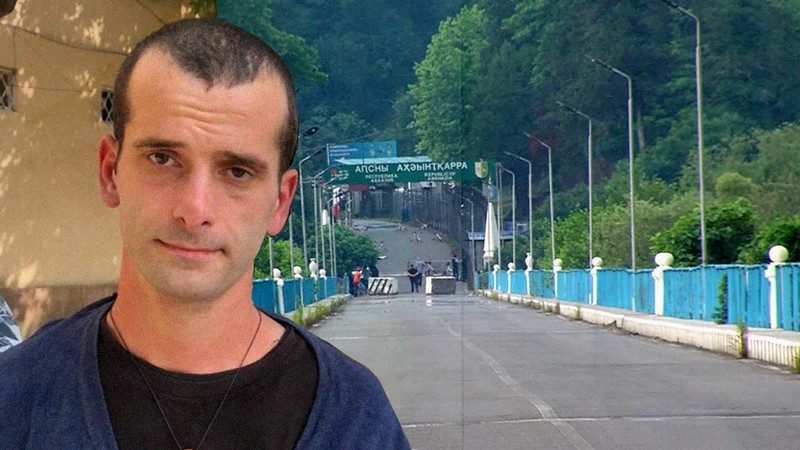
The instigator of all this turmoil — 27-year-old Irakli Bebua — overnight became the most "notorious" Georgian living in the republic. He explained his act as an attempt to establish "friendship" between Abkhazians and Georgians. How burning Abkhazia's chief state symbol was supposed to contribute to this, however, he could not explain. Nor did he try — for it is impossible to connect the entirely unconnectable.
"What nonsense is this idiot talking? What friendship with Georgians can he speak of after humiliating Abkhazians in such a barbaric way?!" says our interlocutor Emma.
Forgetting that the desecration of a country's symbols — in a country where he had lived peacefully for 27 years, on the most important day for the entire people — would bring nothing but hatred, Irakli Bebua recounted the reasons for his "conscious" actions with a smirk on his face. "Neither the paper nor the color bothers me. I did it so that we would not celebrate us not being brothers," he told law enforcement representatives. But his explanation only further inflamed Abkhazian society. Some social media users demanded immediate retribution not only against Irakli Bebua himself but against his relatives as well.
"To the gallows — with his whole family! Let the whole world turn against us — we need to show what his act is worth! Enough humiliating ourselves — they hit us on the right cheek, we turn the left," says Inga Djindjolia.
"Just try burning the Georgian flag in Georgia and see if they let him go. Let's decide what we actually want — deport the family, put him in prison, and let the court decide," writes Inga Ashuba.
User Khajarat Ashua goes even further, believing that Bebua "should be executed in the central square of Gali, and all his relatives and the circle in which he acquired such an attitude toward sacred values should be deported to Georgia."
Credit must be given to the police officers who succeeded in preventing all attempts at unlawful action by enraged citizens toward Irakli Bebua. They not only detained the young man but transported him under escort to Sukhumi.
When passions subsided, Abkhazian society began speaking of provocation. In their view, someone had been directing Irakli Bebua's actions.
"Do you really believe that without any reason this boy suddenly decided to burn our flag? He had participated in preparations for the celebration for several days and had not once expressed a single negative thought about the flag, the war, or the Abkhazians. And then — out of nowhere — he burns the flag. No one is foolish, and we all understand perfectly well that this is a provocation," says our interlocutor Alexei. Who organized it, the man could not say. "I think it was advantageous to many. I do not rule out the hand of the Russians. Perhaps this is how they hoped to set us against the whole world, expecting some sadistic response from us. Anything is possible — I don't rule that scenario out either," says Alexei.
Political analyst Tengiz Djopua even believes that "this may be part of some plan in which Abkhazia comes after Karabakh."
Our interlocutor Ilya took his reasoning further and believes that Irakli Bebua's actions are part of a cleverly planned tactic aimed at driving Abkhazia away from its neighbor across the Inguri. "Think about it — our authorities began speaking about establishing dialogue with Georgia, about trade and economic relations; entrepreneurs and young people began looking toward Georgia — and immediately dozens of problems rained down on our heads. And where did the desecration of our flag occur? In Gali. Why not in Gagra or Tkuarchal? Which means someone desperately needed this to happen precisely in the Gali district. Such things don't happen for no reason," believes Ilya. In his view, the organizers of this shameful act were counting on an Abkhazian reaction that would undermine the republic's image in the eyes of the international community.
Having realized that Abkhazia may have become part of someone's political game, Abkhazian society began speaking of a more humane method of punishing the flag-burner Bebua.
In the view of user Nugzar Solomko, the young man "must be expelled from Abkhazia together with his family." Mikhail Strakhov echoes this, believing there is "no point keeping Bebua in prison — no reason to waste the people's money."
"In any case, this idiot must be returned to them alive. We don't make war on lone lunatics and touring clowns," believes Tengiz Djopua.
The negative reaction of Abkhazia's residents to the desecration of state symbols is, of course, understandable. Irakli Bebua did not merely burn a flag — he encroached upon something most sacred: our Victory Day, a holiday of the deepest significance to every patriot of Abkhazia. And he did so quite consciously. Evidence of this lies not only in his words, but in the very manner of his telling, his facial expression, and his arrogant smirk. But did he conceive all of this himself?
Well-known blogger in the republic Kirill Basilevsky, having read hundreds of furious comments published on Facebook, called on Abkhazian society to act with civility. "On the one hand, you write that Abkhazia must seek international recognition and improve its image as a civilized state — and on the other hand, you carry on like aggressive savages," he wrote on his Facebook page.
And indeed — on the one hand, by demanding medieval punishment, we forget the main principles proclaimed back in 1993 and enshrined in the Constitution of Abkhazia. Before emotions overwhelm reason, we all need to understand who stands behind all this turmoil. I will not claim certainty, but it appears that Georgia needed this least of all.
It is also evident that the puppet-masters standing behind Irakli Bebua were expecting a different outcome from Abkhazians — one whose consequences could have proved very unexpected for us. We have long lived without the support of the international community, despite all the chaos unfolding around us. But however much anyone might wish otherwise, the Abkhazian people have for centuries possessed a wisdom that the entire world only recently proclaimed as the principle of democracy and rights. Our ancestors, without any laws or international instruments, held sacred their own code of rules — rules that to this day stand head and shoulders above all the values that have been proclaimed. And it is vitally important for all of us to return to these principles of Apsua and to live by these unwritten laws.
As for the flag-burner Bebua — I add my voice to those calling for his deportation from Abkhazia. We should not make a hero and a martyr of him, if only to ensure that those who planned this provocation do not achieve their intended goal.
Kristina Avidzba
The text contains place names and terminology used in the self-proclaimed Republic of Abkhazia. Opinions expressed in the publication reflect the views of the author and do not necessarily represent the position of the editorial board.