
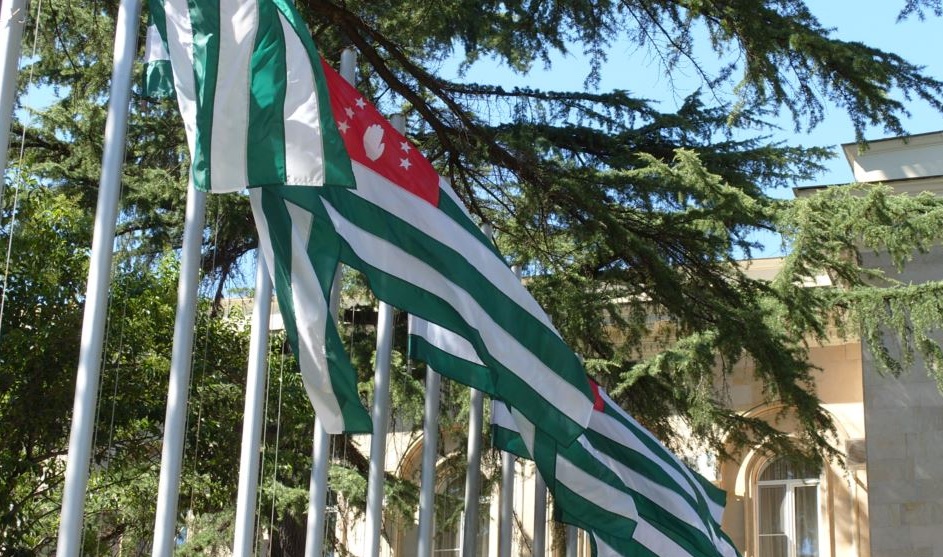
Abkhazian, Georgian, and Other "Patriots" Dealing Blows to Abkhazia on Russia's Behalf
26/09/2020 06:40:56 Conflicts
On September 24th it became known that businessman Jemal Soselia, who had been abducted in early September in the Gali district of Abkhazia, had been released. No official information about the circumstances of his release has yet been forthcoming. Two main versions are being discussed in the Abkhazian segment of social media: 1) Abkhazia's "State Security Service" participated in a special operation to free him; 2) Soselia managed to escape from his kidnappers on his own. Whether the businessman's relatives paid a ransom remains unknown.
Before delving into the thickets of this story, it would be useful to "scroll back" through the general context of events that have been unfolding in Abkhazia recently. To recall that for several months now, barely a day passes there without some new upheaval. That on top of the old — "chronic" — problems, the coronavirus pandemic has brought new ones, connected with the curiously ill-timed financial and medical blockade imposed by the "strategic friend" Russia.
Those who see to the root of things — a growing portion of the population each day, as well as the current "leadership" (at least for now) — have already grasped the main causes of the crisis. They are now trying to find available means of escaping the situation. And one of those means — being discussed with increasing frequency and volume — is cooperation with Tbilisi.
There is, however, a second camp. It consists of all those who, through their "wise," exclusively "patriotically motivated" deeds, brought Abkhazia to its current condition. They now — having apparently "forgotten" all accountability and offering nothing of substance — simply set about systematically vilifying the current "leadership," declaring every proposal it makes "fatally dangerous" and creating obstacles by every available means to any movement in a different direction.
The concept of this latter group runs roughly as follows: there is one single problem that must be fought, and its name is the new "leadership." All the old problems — those that have systematically been driving Abkhazia to its present state over the past years, with their direct participation — are, in fact, not problems at all, but precisely that on which one must continue to rely in order to survive and be saved. You think this is nonsense? It is. But this group seems incapable of anything more coherent. Or perhaps its objective is simply quite different.
The leading role in this camp is played by the former leadership — the team of Raul Khajimba and the veteran organization Aruaa that supports them. And the loudest protests against everything new come from former officials such as the ex-head of the Gali district "administration," Temur Nadaraia. In short, these are all those who are dreaming — under cover of the noise — of taking revenge in an Abkhazia they themselves reduced to this state. Now, in their fervent zeal to return to the reins of power, they do not even stop to consider that in the not-too-distant future — again through their own fault — there may be nothing left to govern and no one left to govern over.
Though let us add a caveat. Perhaps the Khajimba team is not actually quite as blind and mercenary as it appears. Perhaps it is simply being forced to deliver the final blows to a weakened Abkhazia by that very "strategic friend" who has been leading it to this state throughout all the past years — the one whose opinion and wishes the former "leadership" heeded more obediently than the current one (at least for now), particularly on questions of foreign policy orientation. One would very much not want to believe that in causing Abkhazia — during so critical a period — damage that may prove irreparable, this team is acting exclusively in its own pocket-and-suitcase interests; that behind the mask of its "patriotically" motivated accusations lies precisely what it accuses the current "leadership" of — betrayal of the interests of the homeland and the Abkhazian people.
Why did I mention foreign policy orientation? Because all these accusations against Aslan Bzhania's team began raining down precisely after the idea of establishing dialogue and cooperation with Tbilisi was voiced for the first time. Why this is "inadmissible" and "ruinous" — especially in the difficult situation Abkhazia finds itself in after years of "strategic partnership" with Russia — no one from the former "leadership" can explain coherently. Nor does anyone bother to try. Just as no one troubles themselves with a public analysis of who and what brought Abkhazia to this state. Understandably so: that would require acknowledging one's own guilt and mistakes. But sowing panic through various accusations, demands, threats, and intimidation — rocking the boat, disorienting and demoralizing both the current "leadership" and the population — that is "just what the doctor ordered": simple, cheap, and effective — if, of course, one is concerned not with the interests of Abkhazia and its people, but solely with one's own.
It is precisely through the "good offices" of the former leadership's henchmen that the scandal surrounding the visit of representatives of the Georgian "non-party" — the Alliance of Patriots — who supposedly "secretly" slipped into Abkhazia "to deliver an icon to the Ilori monastery," refuses to die down in Abkhazia. The saga continues despite the fact that everyone in Abkhazia has long since understood the following: 1) The initiators of this "secret" affair were Russian officials; 2) There are well-founded suspicions that these "patriots" are also financed by Russia, and this question is already being examined by Georgia's State Audit Service; 3) This party has never represented Georgia, the Georgian people as a whole, Georgia's government, the Georgian Orthodox Church, or any political force of even minor significance — which means presenting some meeting with its representatives as "negotiations with the Georgian side" is simply nonsense and a lie.
And yet despite all of this, Aruaa, Mr. Nadaraia personally — who was the first to broadcast news of this "visit" across Abkhazia — along with all the other revanchists, continue to this day to prevent Abkhazia from forgetting this thankfully failed Russian trick aimed at destroying the just-emerging idea of Georgian-Abkhazian cooperation.
But while still playing that card, they have already prepared a new information strike against Abkhazia. And once again it was the same Mr. Nadaraia who set the process in motion, informing the public of the September 5th kidnapping in the Gali district of "Russian citizen and businessman Jemal Soselia." In doing so, Nadaraia naturally did not forget to mention that "this is the first kidnapping in the Gali district since 2015." And to indicate that the kidnappers were a "Georgian terrorist group" and that the missing man should be sought on territory controlled by Georgian authorities.
But fortunately, Nadaraia is not the only source of information in small Abkhazia, where both fabrications and the truth spread at lightning speed. And he himself probably knows perfectly well who did what there, why, to what end, together with whom, and on whose orders.
If not, allow me to share information from a source within Abkhazia's "Interior Ministry": 1) The kidnapped man was most likely being held on the territory of the same Gali district; 2) A ransom of 180 million rubles was demanded — given the scale of the sum, likely the value of part of his Russian business assets; 3) In addition to Russian citizenship, Jemal Soselia holds an Abkhazian foreign passport — meaning he also holds Abkhazian citizenship — and why Mr. Nadaraia found it necessary to "dramatize" the situation by emphasizing the kidnapped man's Russian citizenship is anyone's guess; 4) There is absolutely no political dimension to this case — in reality, it is an ordinary criminal story of the type of business "seizure" traditional for Russia, in this instance involving Chechen, Abkhazian, and Georgian criminal elements. The affair began in Russia itself, continued in Turkey, and concluded in the Gali district.
To be more specific: Soselia, who had for some time been troubled in Sochi by local Chechens attempting to appropriate his business, turned for help to certain "thieves-in-law" based in Turkey. They, in turn, reached out to local — Georgian and Abkhazian — criminal figures in Abkhazia, where Soselia had recently arrived, to resolve the matter. However, these same intermediaries apparently decided to profit from the situation themselves — hence the kidnapping. Mr. Nadaraia is surely aware that among the five kidnappers he dubbed a "Georgian terrorist group," there were Abkhazians as well. And it would not be a bad idea for him to grasp that criminality has no nationality.
But it is clear that properly making sense of what happened was the last thing on Mr. Nadaraia's mind — his goal was to throw yet another stone into the garden of Aslan Bzhania's "leadership" and of Georgian-Abkhazian cooperation.
One wonders: how do he and his associates envision the outcome of all their activities of this kind? Do they understand what Abkhazia's long "cooperation" with Russia has brought it to? If so, why do they continue their attempts to grab Abkhazia — which "dared" to turn its head slightly — by the reins and return its gaze to the "only possible" Russian direction?
Were I a resident of Abkhazia, I would put to these gentlemen at least one question: What benefit did they bring to Abkhazia "as a state" during their time in "power"? What advantages were they able to secure for their people in the social sphere, the economic sphere, in healthcare, education, or in any other domain?
Gvantsa PIpia
The material was prepared as part of a joint project of the Accent news agency and the non-governmental organization GRASS, implemented with the financial support of the Embassy of the Czech Republic in Georgia.