
Why Russian Military Personnel Behave as Masters of Abkhazian Land
25/09/2020 08:43:31 Conflicts
The fundamental law of the state — the supreme normative legal act of the Republic of Abkhazia — endows its citizens with a wide range of rights and freedoms. This multi-page document guarantees every person, alongside equality before the law, the right to life, liberty, personal inviolability, and much else. For instance, Article 16 of the Constitution of the Republic of Abkhazia proclaims every person's right to freedom of movement and choice of place of residence. According to the document, any citizen of Abkhazia may move freely throughout the republic. In practice, however, the reality is diametrically opposed to the order enshrined in Abkhazia's Constitution.
So as not to make unfounded claims and to avoid misleading readers, let me give examples — and more than one. Several years ago, Abkhazian citizens first encountered a ban on entry to certain villages in the republic. The ones restricting their right to move freely across the territory were none other than Russian military personnel. I should note that we are not speaking of strategically significant facilities, but of ordinary homes belonging to local residents — the road to which Russian military personnel block.
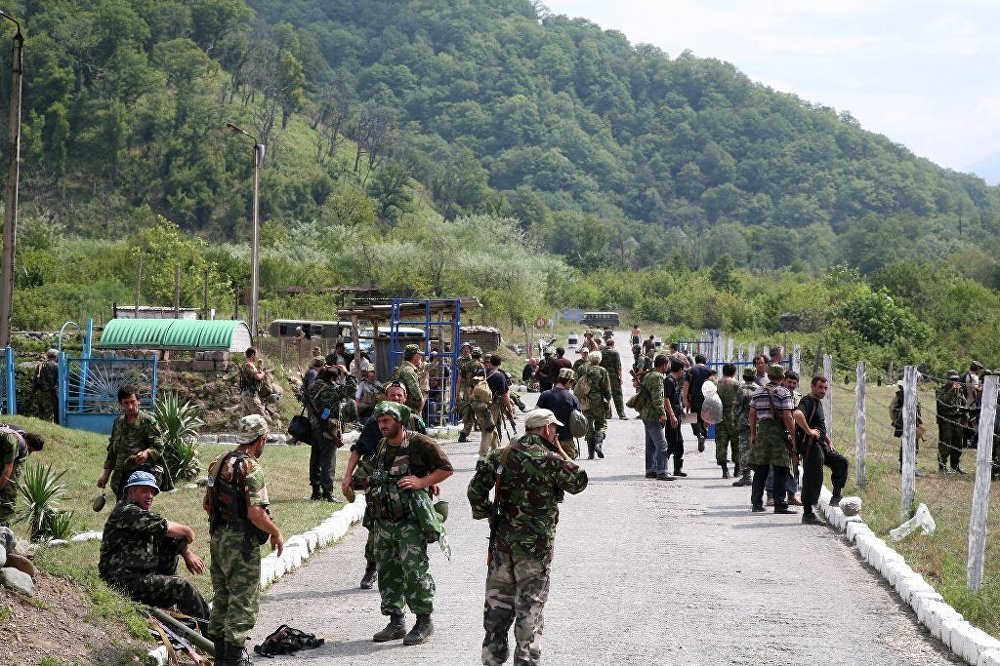
Access to the Kodori Gorge after August 2008 was controlled exclusively by Abkhazian security services. A checkpoint was established there, which was modernized annually and after a couple of years became a fully functioning roadblock. Entry to the territory was only possible with the permission of Abkhazia's State Security Service, which, after a lengthy vetting process, issued the visitor a pass. Now Russian military personnel are stationed there, and gaining access to the gorge is extremely difficult — for an ordinary person, effectively impossible. Passes are still issued by the republic's State Security Service, but the screening is now conducted by Russian specialists. And it is they who decide who may and who may not enter the territory of the Kodori reserve.
The situation in the Gali district is much the same. Only there the checkpoints resemble abandoned bus stops, from which people in camouflage uniforms with assault rifles suddenly emerge. Without any explanation, they demand identity documents from all vehicle passengers and pedestrians. If a family member has forgotten their identity document at home, they will be required to get out of the car — the military will not permit the whole group to continue. They also conduct a thorough inspection of the vehicle, luggage, and even bags containing personal belongings. Any attempt to find out by what right you are being obstructed and prevented from moving freely through village territory will be fruitless. Press the matter too insistently and Russian military personnel will call a patrol to take you away in an unknown direction. This is why people most often say nothing about the lawlessness being committed against them — fearing the punishment that will befall them should they spread the information.
A similar situation exists in many other districts of Abkhazia, where Russian military personnel behave as the masters of Abkhazian land. You will find no recourse against them. And if you do decide to resist their arbitrary behavior — enlisting the help of quite influential people and organizations — you will be released to avoid a scandal. But only for a time. You will find yourself under the close attention of Russia's FSB wherever you are in Abkhazia.
"The first time I encountered military personnel demanding to see my passport and driving license, I was completely taken aback. How can this be? I am driving to my sister's home; I am a citizen of Abkhazia; this is Abkhazian territory — and I am being searched as if I were a criminal," our interlocutor Aynar told us. According to the man, he could not understand what the Russian military wanted from him. All his arguments about the unlawfulness of such actions had no effect whatsoever. "Because I had not brought my passport with me, the military refused to let me through and turned me back to Gagra. Who gave them the right to decide for me when and where I travel? Are we now unable to step outside our own homes without a passport — are we under martial law or something?" the man asks indignantly.
Unlike Aynar, local resident Sariya was even less fortunate. She recalls her encounter with Russian military personnel in the Tsebelda area with horror. Many years have passed since that day, but she remembers everything as though it happened to her yesterday. The young woman spent ten hours in a cell at one of the nearby military bases, to which she was taken after she insisted too persistently on being allowed to go home. She had gone to the Sukhumi market to do some shopping and had left her passport at home. On her way back to her village, she encountered the military personnel controlling that area. She knew many of them by name, having spoken with them on previous occasions. But this did her no good in getting home. "I spent a whole hour explaining to them why I was without my passport. They did not care. They demanded that I leave the area, as apparently they could not let me through without a passport," she says. At home, Sariya had two young children and an elderly grandmother who, because of her age, would not have been able to bring her the passport even if she had wanted to. "I offered to leave all my bags behind and walk home to get my passport, but they refused. When I declined to leave — there was nowhere for me to go, my home was right there — the military twisted my arms, threw me to the ground, and called for reinforcements," the young woman recalls. According to Sariya, everything that followed is difficult to imagine, as it is the kind of thing one only sees in action films. "A military vehicle arrived, and soldiers with weapons poured out of it. A bag was thrown over my head and I was shoved into the vehicle. The bag was removed in a room containing only a table and a chair. In the corner stood a bucket — I understood that was supposed to serve as a toilet," Sariya recounted. She was kept locked in this room for more than ten hours, after which she was brought back to Tsebelda again with a bag over her head. As they released her, the military warned her not to be caught without her passport again — because next time, she would not "get off so lightly."
If you speak with residents of remote villages, you will hear many such stories. But officially, none of them have made any statements or sought help anywhere. When asked why, our interlocutors explain that there is no point in complaining. The Abkhazian authorities are powerless to act, since the majority of villages have been left to the mercy of Russian military personnel, who impose their own rules of life on the local population. "They are the masters here. No one is going to damage their relations with them on our account — I understood that long ago. And so we live, trying to avoid catching the Russians' eye unnecessarily. Who knows what new idea will occur to them next — tomorrow they may demand some other document instead of a passport. And if we don't have it, we can say goodbye to our home, our children, our loved ones," believes Sariya.
I began this article by describing the Abkhazian Constitution — which holds supreme legal force across the entire territory of the country. It still enshrines all the rights and freedoms of Abkhazian citizens. But in practice, Russian military personnel have more power than the state's foundational document, to which not only the republic's citizens are obligated to adhere, but also representatives of other states — even those providing Abkhazia with military assistance.
How to make sense of a situation that has long since become established, I cannot fathom. One thing is absolutely clear to me: with the connivance and tacit approval of the authorities, Russian military personnel are committing abuses on Abkhazian territory. The local population resists this lawlessness as best it can. But their strength is clearly insufficient to rein in and call to order the military personnel billeted throughout Abkhazia's territory.
A state that is primarily obligated to protect the rights of its citizens must bring to heel the military representatives of its strategic partner — reminding them that Abkhazia is a sovereign and free state whose laws they are obligated to observe. Otherwise, all of this risks spilling over into a conflict whose greatest victims will once again be the local population, whose living conditions can already barely be described as humane.
Astanda Bgamba
The text contains place names and terminology used in the self-proclaimed Republic of Abkhazia. Opinions expressed in the publication reflect the views of the author and do not necessarily represent the position of the editorial board.