
Abkhazia. Moscow Time. Hope Is Dwindling
10/09/2020 17:19:20 Conflicts
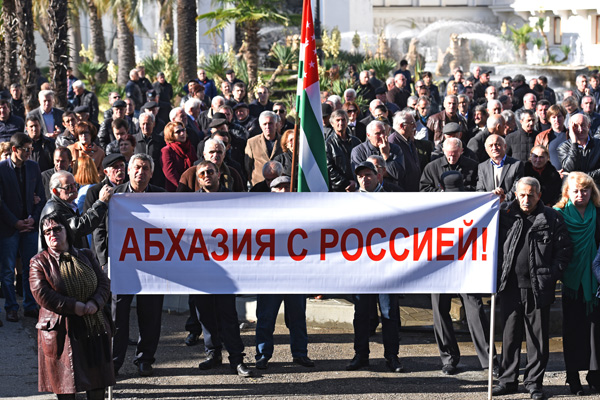
On the eve of the "Day of International Recognition of the Republic of Abkhazia," "Foreign Minister" Daur Kove gave an interview to the outlet Apsnypress. If one compares it with similar interviews from previous years, one will find virtually nothing new in it. The same old phrases about how "recognition by Russia is truly one of the most important events in the country's recent history," and how "citizens had waited so long for this, hoping for the protection and patronage of the Russian state." However, against the backdrop of the recent cooling of Russian-Abkhazian relations — something that has long been no secret to ordinary residents, though Abkhazia's leadership once again tried diligently to "paint over" it in its celebratory statements — the new interview does contain a couple of phrases that point to something new: an emerging pessimism.
For instance, Kove says: "We have already grown accustomed to it [recognition], we take it for granted, and at times we do not fully appreciate the significance of the events of August 26, 2008."
This is, of course, followed by "reassuring" phrases about how "little Abkhazia received diplomatic recognition from the world's largest state, an influential international player, a permanent member of the UN Security Council," and that "the people of Abkhazia received a long-awaited chance for safe and steady development." But today — twelve years on — all of this sounds far less encouraging than it did in the early years, when Abkhazia's residents genuinely believed in the "comprehensive assistance" promised by Russia. The process has been moving far too sluggishly. Far too few people can feel any promised positive changes in their own lives. The promised bright future is far too indistinct on the horizon.
And while Kove explains the shift in mood as a result of "habituation," everyone understands that this is hardly the only explanation. The main cause of the pessimism is the absence, twelve years on, of results even remotely approaching what was desired — except, of course, for "security protection," for that part of the population still convinced of Tbilisi's fierce desire to "attack, tear apart, and destroy." This is why the phrase about "a long-awaited chance for safe and steady development" sounds unconvincing — particularly with regard to the key word "development." In other words, faith has not faded because people have grown accustomed to security, but because no development has followed — not economically, not in terms of international recognition, not in terms of strengthening state institutions, not in terms of democracy, not in terms of protecting the rights and freedoms of citizens — not in anything. And most importantly, to this day no one in Abkhazia observes any particular signs that development will begin tomorrow.
While it might not be entirely fair to hold Kove directly responsible for the difficult economic situation or insufficient protection of rights and freedoms, international recognition is his domain. And the results of twelve years of activity — first by his predecessors, then by Kove himself — sound rather modest. After Russia, under its own pressure, Abkhazia was recognized by Venezuela, Nicaragua, and Syria — countries with dubious reputations and unstable international positions — as well as three island states: Nauru, Tuvalu, and Vanuatu, though the latter two subsequently annulled their recognition.
That is all there is to date. And what of tomorrow? The statements of the "minister" himself — the official responsible for fulfilling the set foreign policy objectives — look less like a forward-looking plan and more like an attempt to justify the reality of stagnation: "The work of advancing international recognition is a lengthy, complex process. [...] One should not expect immediate results. [...] To the question of what the prospects are for other countries recognizing Abkhazia's independence, there can be no simple or unambiguous answer. The prospects for recognition depend on a whole range of factors, the significance of which may shift over time."
One of the main such factors, according to Kove, is "the deliberate policy of Georgia, enjoying the patronage of the US and EU, of fully isolating Abkhazia from the outside world." And yes, the international community's policy of non-recognition of Abkhazia and South Ossetia — which Tbilisi and its international partners regard as territories occupied by Russia — is indeed one of the most important directions of Georgia's foreign policy. But the claim of "the full-scale isolation of Abkhazia from the outside world," made by Abkhazia's chief diplomat, sounds, to say the least, unfair. What about all the peace initiatives that Tbilisi has tirelessly continued to offer Abkhazia in recent years, a significant portion of which opens for Abkhazians the shortest and most comfortable paths precisely toward engagement with the outside world?
Ordinary citizens may still be unaware of this. But who better than "Minister" Kove knows that there is only one stumbling block here — the question of Abkhazia's political status. And that this stone was not placed on the path by the Georgian government. After all, by developing in 2018 the by now well-known initiative "A Step to a Better Future," Tbilisi demonstrated in practice a genuine readiness to set all political questions aside and create new economic opportunities that bypass the question of political status. Had Sukhumi, following Tbilisi's example, begun to realize all of these opportunities in the spheres of medicine, education, economics, and trade, ordinary citizens would be breathing considerably more easily right now. They would be engaging with the outside world today not merely without obstacle, but under maximally comfortable conditions created specifically for them — and without any political obligations or concessions.
What value alone lies in the opportunity for Abkhazian products to reach international markets with preferential rights and free of taxation! Or to receive a free education at a leading European university! And all of this — entirely status-neutral, without acquiring Georgian citizenship. Does this really look like "the full-scale isolation of Abkhazia from the outside world"? I do not think so. It looks more like a rather good opportunity for precisely the development whose absence is generating mass pessimism in Abkhazia.
If one is to speak of "isolation from the outside world," who better than the "Foreign Minister" knows who it was that once would not allow Abkhazia to establish close ties with its diaspora in Turkey, Syria, and Jordan. Who even now instantly begins creating every possible obstacle at the slightest stirring of Sukhumi in the direction of cooperation with anyone else — and not only Tbilisi.
Of course, Abkhazia's chief diplomat will not say all of this publicly. But he cannot have failed to notice those strange coincidences that have outraged virtually everyone in Abkhazia in recent months. First came the gradual reduction and then complete cessation of financial assistance. Then the extraordinarily unconvincingly justified closure of the border on the eve of the tourist season — so vital in summer for many Abkhazian families. Then the effective medical blockade during the pandemic. Then the hours-long pension queues for elderly people in the midst of an epidemic. And finally, direct dressing-downs and threats directed at Abkhazian officials behind closed doors.
By now, practically every resident of Abkhazia knows who orchestrated all of this and against what backdrop. All of these are moves by Moscow, intensifying with each passing day against the backdrop of the increasingly vocal ideas within Abkhazia about possible cooperation with Tbilisi. There is nothing surprising in the fact that the population has perceived this as punishment for "looking in the wrong direction." Nor is there anything to wonder at in the extreme indignation of Abkhazians.
And yet it was all clear back in 2014 — even earlier, when the draft text of the so-called major Russian-Abkhazian agreement appeared, envisaging the merger of a whole series of Russian and Abkhazian state structures, including the most vital systems of any functioning state. Or to speak entirely frankly — not a merger at all, but quite simply the absorption of Abkhazian structures into Russian ones.
Abkhazian society already sensed something was wrong in 2014 and was already expressing outrage. Some people evidently still refused to believe that the most formidable obstacles to development were being placed by that same single "friend" on whom they had been relying for all twelve of those years.
Now, however, when the majority of ordinary citizens have observed with their own eyes the changes in the behavior of the "strategic brother," many have begun to voice doubts about the true nature of his intentions. And fears that Russia may be probing the ground so that one day it can simply annex Abkhazia have crept into the minds not only of ordinary citizens but of experts as well. Some of them now speak not of probing, but of "full-scale preparation for resolving this question."
As for official figures — they should have no doubts on this score whatsoever. Many Abkhazian officials have been given hints by Russian representatives about such intentions on more than one occasion. One such episode occurred in the very recent past — during an inspection of Abkhazia's energy infrastructure by Russian specialists. "You do understand that the integration of your energy system with ours is a matter of the near future. Everything must be done very promptly and efficiently, so that Russia does not end up inheriting an Abkhazian energy sector burdened with major and complex problems" — this is what representatives of the Russian agency told the Abkhazian side, "off the record."
The indignation expressed by one of those present at that "inspection," speaking on condition of anonymity, is entirely understandable: "They spoke as though the question of integration had already been decided and we were merely walk-on players required to carry out a certain task. It felt as though everything had already been settled and these specialists had come here to give us our instructions and make sure we carried them all out."
And yet, against the backdrop of everything described above, "Minister" Kove states in his interview that "Abkhazia's leadership is in constant contact with Russian counterparts, aligns its positions on the most pressing problems, holds regular consultations, and maps out plans for the future." And this — after twelve years that have produced a reality forcing citizens, with each new day, to lose what little optimism remains.
Perhaps it is time, then, to stop "checking the clocks" exclusively with Moscow.
Ekaterine Tsanava
Opinions expressed in the publication reflect the views of the author and do not necessarily represent the position of the editorial board.