
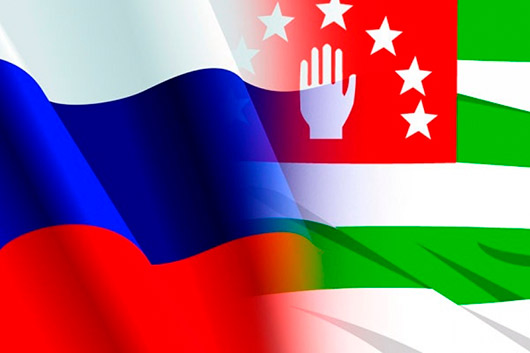
The Russian-Abkhazian Wedge: Why Abkhazians Are Aggrieved at Their "Strategic Friend" and Why They Fear Forced Annexation
09/09/2020 07:52:43 Conflicts
Horses, people — everything has become jumbled in the Abkhazian household. In other words, Abkhazia is gripped by a period of complete confusion. The last month of summer became, as one might say, a period of revelations for the republic. Against the backdrop of a sharply rising number of Covid-19 infections, quarantine measures, and various restrictions, Abkhazian society has been shaken by one scandal after another — and not only of a political nature.
The republic entered a phase of even deeper division because of the icon "donated" to the Ilori church by representatives of a political party widely regarded as odious in Georgia. To this was added the ill-fated interview of Russian State Duma deputy Konstantin Zatulin, who, under the guise of equal rights for Abkhazian and Russian citizens, once again raised the issue of selling real estate to foreigners.
Speaking with the director general of the Abkhazian state channel about Abkhazia's refusal to sell its land to Russians — who are, in Zatulin's words, exactly the same as Abkhazians — he noted that "the desire to be known as patriots [...] sometimes prevails over common sense."
The reaction to the Russian politician's remarks was instantaneous. The Abkhazian segment of the internet was flooded with comments about Russia's interference in Abkhazia's internal affairs.
"Abkhazian legislation is the sovereign domain of the Abkhazian people. The argument about 'equal rights' is a substitution of concepts and a manipulation. We have dozens of reasons not to open the residential real estate market to foreigners — and not only to Russians. Russia may dispose of its own real estate as it sees fit, but the rights it grants to foreign citizens cannot constitute an obligation for us," believes Adgur Lagvilava, a representative of the Abkhazian youth party Aynar. In his view, a person who positions himself as a friend of Abkhazia — a politician with many years of experience — should not and has no right to speak in such terms.
In his interview, Konstantin Zatulin also spoke with evident grievance about the fact that the reasoning of Abkhazian youth, who perceive Russia's assistance as nothing other than a financial drip, cannot be considered either measured or serious. "We read that Russia is supposedly already to blame for having put Abkhazia on the needle by providing assistance and thereby paralyzing the creative energies of those Abkhazian businessmen and entrepreneurs who supposedly could have brought prosperity to Abkhazia. What concerns us in Russia about the development of our relations and about the internal state of Abkhazia generally is that many issues which should have been resolved long ago in order for it to develop at an accelerated pace have unfortunately been deferred."
This statement by the Russian politician triggered a storm of protest. Abkhazian society perceived it as a kind of probing of the subject of the republic's accession to Russia.
Abkhazian economist Anatoly Otyrba is convinced that this is not probing but full-scale preparation for resolving this question. "Unfortunately, certain forces and individuals are preparing for this. The reason is singular — our intellectual weakness, the consequence of which is our inability to articulate our position clearly and with well-grounded arguments," believes Otyrba.
The prolonged period of problems and catastrophes — including of an economic character — that experts of all stripes had been predicting appears to have arrived in Abkhazia. To put it briefly, the country has been experiencing delays for several months in the payment of pensions, benefits, and salaries — including those of the medical staff treating patients at Abkhazia's only Covid hospital. ATMs are empty, and there have long been no queues in shops. There are, however, queues at savings bank branches, where pensioners are compelled to collect their meager payments — by the grace of Russian pension fund officials — during the acute phase of rising Covid-19 infections.
The situation is, to speak plainly, critical. Even during the blockade that Russia imposed on Abkhazia, cutting it off from the rest of the world, there was no such despondency in society. Now people are inclined to think that all the misfortunes raining down on Abkhazia's head are not accidental, but punitive. "How can this be — just think about it yourselves? Russia is so large and powerful, and yet it tries to measure its strength against ours. What for? Can the desire to seize our lands really be so strong in Russia that they are prepared to kill us here while we're still alive?!" asks Maria, a resident of Sukhumi.
"One thing after another. When will this end? We live as if on a powder keg — if this can be called living at all. At one moment they're organizing some kind of meetings with their Georgian friends here, at the next they're intruding into our lives, making demands, making requests, making threats. And this will never end," is the conviction of Alexander, another Sukhumi resident.
In the view of most of our interlocutors, relations with Russia have deteriorated recently because Abkhazia openly began declaring the possibility of dialogue with countries other than Russia. "Russia is a proprietor. And the moment we turned our gaze in another direction, they immediately began perpetrating a genocide against us. I can find no other word for what is happening. How else does one describe the fact that reproaches, blackmail, and setups immediately started flying our way in response?" says our interlocutor Adgur.
The fact that Russia is aggrieved at Abkhazia simply for wishing to establish dialogue with other neighbors — for seeking a way out of a difficult economic situation — can be discerned from the statements of politicians in the neighboring state. They do not say this openly; the principle of diplomacy has not been abolished. But the entire context of their communications is thoroughly permeated with such reproaches. Take Zatulin alone, who in every other breath speaks of love and support for Abkhazia, which refuses to become a normal state, does not want to build its bright future, does not appreciate everything Russia has done for it. One would like to ask this wise politician: has Russia ever given Abkhazia a single chance to become stronger, more democratic, and more independent? Konstantin Zatulin is unlikely to answer — and even if he were to condescend to do so, he would never admit that for many years Russia has commanded and controlled Abkhazia, making it ever weaker and more dependent.
For the first time since the post-war years, Abkhazia has begun openly speaking about the possibility of dialogue with Georgia. Many in Abkhazian society are extremely sensitive on this question. But despite those voices, those who regard such a possibility as a vital necessity at this moment are growing louder with each passing day.
"As for Abkhazian-Georgian communications at the level of civil organizations, expert platforms, and institutions — I see no problems whatsoever. Communicating and discussing is both necessary and right. But without farce and cheap spectacle. With maximum transparency, clarity, and within the bounds of the law!" believes Renat Karchaa, adviser to the President of Abkhazia. In his view, "secret suppers," contacts pursued with an insufficiently thought-through purpose, and violations of norms and procedures are unacceptable and fraught with consequences. And the further inflaming of passions in the socio-political sphere will lead to nothing but collapse.
In Renat Karchaa's view, in the current situation and facing contemporary challenges, Abkhazia could easily lose its way entirely — wandering off and never finding its way back. "My suggestion is therefore very simple. First, calm down, stop multiplying 'enemies,' and begin thinking about how to build activity in this sphere systematically — speaking the language of proposals and recommendations, not of shouting, insults, blackmail, and threats," believes the presidential adviser.
But whatever Abkhazia's intentions may be, however earnestly it may wish to put its foreign policy in order and establish dialogue, Russia will in all likelihood not permit it to do so. One does not wish to paint too dark a picture, but for insubordination the strategic partner will punish Abkhazia — and in a highly sophisticated manner.
Whether this proves to be the case, time will tell. And the republic's residents are left with nothing but to observe the strange development of Russian-Abkhazian relations — into which, it would appear, a serious wedge has already been driven. More than one, in fact.
Kristina Avidzba
The text contains place names and terminology used in the self-proclaimed Republic of Abkhazia. Opinions expressed in the publication reflect the views of the author and do not necessarily represent the position of the editorial board.