
An Icon as a Weapon Against Bzhania and the Embryonic Georgian-Abkhazian Settlement
28/08/2020 06:43:07 Conflicts
The concepts of patriotism, faith, and humanitarian work — as well as the words "patriot," "shared faith," and "assistance" — should, in principle, carry only positive connotations for each of us. However, in recent years, in practically all post-Soviet countries and beyond, people have begun to regard them with a degree of wariness. The Kremlin is simply too fond of these words. And far too often, political forces and various events whose names feature them turn out to be, directly or indirectly, serving the Kremlin's interests.
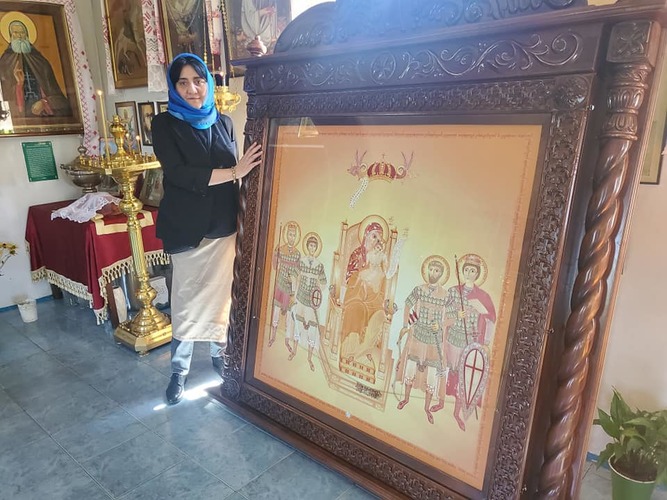
It was precisely such associations that were triggered in Georgia, on the very first day the information spread, by the "secret" visit to Abkhazia of the Alliance of Patriots, whose leaders — Irma Inashvili and Giorgi Lomia — brought an icon to the Ilori monastery on August 18th. And subsequently, when some Abkhazian politicians confirmed that this visit had been organized "at the request of certain Russian officials," virtually no one in Georgian society retained any doubts about the true nature of this "humanitarian-patriotic-godly" undertaking.
Talk of this "Alliance" being backed by Moscow has been circulating for some time. The basis for this is simple: the Patriots' policies align far too closely with Russia's interests. They actively oppose Georgia's integration into European and Euro-Atlantic structures, and oppose the European democratic values so frequently criticized by Russian leaders. Which means that in the Alliance, the Kremlin may well see a force in Georgia worth leaning on. Of course, the "Patriots" as a party amount to very little, and no one has ever taken them particularly seriously. But among even moderately serious Georgian politicians, the Kremlin has failed to find a sympathizer. Hence the need to make do with such marginal figures, who in no way represent the interests of the majority of the population — and this despite the entire powerful propaganda machine, the army of trolls, and the millions spent annually by Moscow on this endeavor. The Patriots' frankly unimpressive rating — between 3 and 5% according to various polls — is hardly surprising. After all, they are fighting against precisely the pro-Western course, the democratic values, and all the attendant benefits in favor of which the Georgian people have already cast their vote on multiple occasions.
And then came the publication of the results of a journalistic investigation by the Mikhail Khodorkovsky Centre "Dossier," according to which Moscow has placed its bets on the Alliance for the upcoming parliamentary elections in October — allocating eight million dollars for it, hiring pro-Kremlin PR strategists, and so on. The question of the Alliance of Patriots' pro-Kremlin orientation was thus brought definitively to a head.
The self-described pro-Western part of the opposition — the National Movement and European Georgia — applied to the Prosecutor General's Office, pointing to signs of specific criminal offenses and demanding that the Alliance be denied registration for the elections. Human rights NGOs, also sharply critical of the Patriots on account of their repeated xenophobic and discriminatory statements, are demanding that the State Audit Service also look into the Alliance's funding — since in 2019, the largest revenue after that of the ruling Georgian Dream (more than 1.5 million lari) was recorded precisely by the Patriots.
The Prosecutor's Office has not yet announced its decision on whether an investigation will be opened. This delay is troubling the pro-Western part of the opposition, which, citing various episodes, maintains that the Patriots are the "pocket opposition" of the ruling Georgian Dream and that they act in concert under Kremlin coordination with the aim of discrediting the West.
Inashvili herself denies all the accusations, calls the scandal that has erupted in Tbilisi "a pre-election fabrication by political enviers" — though what there is to envy is unclear — and connects it, among other things, to this very secret visit, which she describes as "a ray of light" containing "no political dimension whatsoever."
The visit did take place, of course. And the icon was delivered. But was any of this really "a ray of light"? To understand that, let us look at the results.
For the parishioners of the Ilori monastery — which over recent years has been transformed by Russian "specialists" into something quite different — the delivery of the icon might have constituted a certain "ray of light." That is a question worth putting to the parishioners themselves. But literally a few days after its delivery, on August 27th, the Church Council of the Abkhazian Orthodox Church issued a statement refusing to accept the icon, announcing its intention to return it. "This mission was carried out without notifying the leadership of the Abkhazian Orthodox Church. Such actions are inadmissible until the Abkhazian Orthodox Church and the Abkhazian state are recognized by the Georgian Orthodox Church," the statement of the AOC Church Council reads.
For the small number of Alliance of Patriots supporters, the visit to Abkhazia — just like their numerous visits to Moscow — may well have provided another "ray of light." And this "ray" would have warmed their hopes for a Leninist-style "bright future" for a while — until it became clear that it never warmed anything else. But given the scandal that erupted over the matter in Abkhazia, even this ray "deflated" — sooner than the Patriots had calculated. Which means the party itself gained nothing from this foolish pre-election PR stunt. Because the party's leaders now face a far greater challenge in convincing their naive electorate that the Alliance of Patriots of Georgia is a force with whom anyone serious in Abkhazia would discuss anything serious.
The Georgian authorities likewise gained nothing from this "ray of light": their opponents now have pointed questions about the unimpeded passage of Inashvili and Lomia through the closed Inguri crossing — including through the Georgian checkpoint. And along with the questions, additional arguments to speak of an alliance between the ruling Georgian Dream and pro-Kremlin forces.
The comparatively new Abkhazian leadership evidently gained nothing from the "ray" either — it only added a headache. The veterans of Aruaa, who support the revanchist-minded former leadership of Raul Khajimba and are just waiting for the slightest pretext to "take the people to the streets," were handed a tasty morsel for yet more talk of "betrayal of the homeland and state interests."
The resignation of "presidential adviser" Lasha Sakania — who had received Inashvili and Lomia — is unlikely to help matters here. It is not his head that the Khajimba faction is after. For it is unofficially known to everyone in Abkhazia that the title of "presidential adviser" was a mere fiction, and that Sakania was in reality a go-between who delivered, at the appropriate time, the appropriate funds, documents, and information from Moscow — whose interests the former Abkhazian leadership served considerably more diligently. It is precisely this unofficial intermediary role of Sakania's that gave rise to speculation that the Patriots had not traveled to Abkhazia to deliver an icon at all, but to receive funds and instructions from Moscow.
And finally — the last, and perhaps most significant, outcome of this "ray of hope at the request of certain Russian officials." It is the practical marginalization of the first tentative preconditions for a Georgian-Abkhazian settlement that had begun to emerge under the current Abkhazian authorities.
The conclusion, in my view, is simple. There is only one winner from this entire "patriotic-godly-humanitarian" commotion. And it is certainly not Sukhumi or Tbilisi. It is the party that benefits from neutralizing every useful attempt at progress. The party that needs to "punish" Abkhazia — which it itself abandoned during the most difficult period of the pandemic — for "looking in the wrong direction." The party that is forcibly dragging it back into the current of the politics of "one step left, one step right — execution."
Taking all of the above into account, Georgian analysts are convinced that everything that has occurred is nothing more than an unnecessary storm in a teacup, and the sooner it subsides, the better for both Sukhumi and Tbilisi.
"It would be a grave mistake to attach particular significance to this strange visit. After all, it is perfectly well known that the Alliance of Patriots is not a political force capable of representing the Georgian people or speaking in its name. On the contrary, this party fights against the pro-Western democratic choice of the Georgian people. The Alliance of Patriots represents no one but its own mercenary interests. It has neither the desire nor the capacity to create any practical, rational, or positive agenda for Georgian-Abkhazian dialogue and cooperation," says Paata Gaprindashvili, Director of the Georgian Reform Association.
In his view, "any rationally thinking, responsible politician who genuinely cares about the interests of the people will understand the inadmissibility of allowing this populist pre-election PR stunt to create any obstacles on the path of the so-urgently-needed dialogue and cooperation, the outlines of which have begun to emerge of late."
Ekaterine Tsanava
The text contains place names and terminology used in the self-proclaimed Republic of Abkhazia. Opinions expressed in the publication reflect the views of the author and do not necessarily represent the position of the editorial board.