
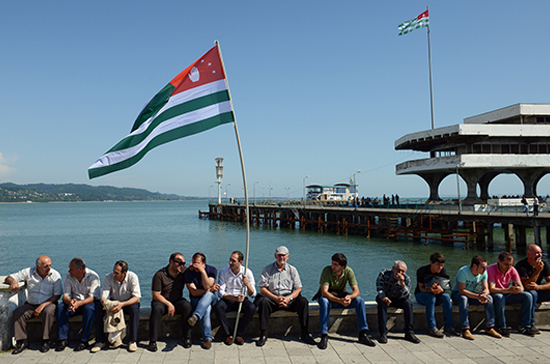
Abkhazia 2008–2020: Why Faith in a Better Future Is Only Fading
14/08/2020 10:08:56 Conflicts
Twelve years ago, the Russian Federation recognized the independence of Abkhazia and South Ossetia. Over the years that have passed, relations between the states have seemingly grown stronger — yet by ordinary people's assessment, expectations were greater.
Many residents of Abkhazia regarded this recognition as a great miracle that would help the republic become a prosperous state.
But in the view of ordinary Abkhazian citizens, the era of flourishing never arrived. The republic has sunk ever deeper into internal problems, grown economically weaker to an extreme degree, and with each passing year faith in a stable future only dims further. If one compares the reactions of Abkhazia's residents from 2008 and the years immediately following with those of the present period, the scale of the despair is evident.
In Maria's view, nothing has changed in the lives of ordinary people — and nothing is changing now. "When we were recognized, I thought things would get better in the country, better for ordinary people. But nothing has changed for us. Maybe some people live well, but there are very few of them. What this recognition has given us — I still cannot understand."
Forty-seven-year-old Said goes even further, believing that after recognition Russia deliberately weakened Abkhazia, and that the fact that the republic's independence was recognized only by states over which Russia had influence can be seen as a disservice: "I thought there would be some changes on the legislative front. And generally I expected a great deal from recognition. The state is being built up, if at all, somehow far too slowly. And in the meantime, the faith in a good future that existed right after recognition has faded. To be honest, I no longer believe that anything will change in our country. And I am certain that Russia doesn't want us to become independent either — it suits Russia better to have a weak Abkhazia at its side. And we ourselves are doing nothing to get the country back on its feet and stop begging Russia for money."
Unlike our previous interlocutors, there are many people in the republic who, despite everything, continue to believe in a positive outcome. But even they consider that saving the country from collapse and ruin is the business of its own residents — not of the large neighbor, which, by recognizing the independence of Abkhazia and South Ossetia, brought a great deal of trouble down on its own head.
"We stopped expecting problems from Georgia's side long ago — Russia took care of that. But things aren't moving forward either. That doesn't mean it's all over, though. Russia will probably continue to do something to get us recognized by other states. But we ourselves also have to do something. Recognition alone won't put food on the table," says Samson, a resident of Ochamchira — a brief comment containing a great many "buts." This is not negation, the elderly man assures us, but merely doubt.
A similar uncertainty runs through the words of those recalling the day of Abkhazia's recognition of independence.
"It was a great celebration. Something like a wedding for about 30,000 people — but without the drinks or the lavish table. People came to Freedom Square from the heart. On that day — August 26, 2008 — you wanted to sing, to dance, to celebrate, and to embrace everyone you met, even strangers. Joy was overflowing and you wanted so much to share it with every person you encountered. It was the first day of a new era, a new age of Abkhazia. And the fact that I was part of that event, that I personally took part in it, filled me with faith and hope," recalls a resident of Sukhumi, remembering events twelve years past.
According to Anna, on that day the voice of Dmitry Medvedev — then President of Russia — was the most beautiful in the whole world. "We listened to him with bated breath. And every word he spoke filled the soul with joy. Everyone rejoiced like children. And we knew that from now on everything would be different. Better, more beautiful, more wonderful." Twelve years on, she admits that her optimism and faith in a bright future have largely faded. "In the first few years there were always some excuses for why the bright future wasn't arriving. Now I no longer believe that any improvement will come," she says.
Stanislav agrees with her — he, like Anna, received the news of Abkhazia's recognition of independence in the capital's main square. "We always counted only on ourselves. Russia provided us with assistance, but we are obliged to rely only on ourselves. We always knew that if it came to it, we would have to defend our homeland ourselves, develop the country ourselves. And Russia would not be very willing to help us. But back then, on that day, we probably just didn't feel much like thinking about that," says Stanislav.
All of our interlocutors acknowledge that relations with Russia have changed in recent years. Where they differ, however, is in their assessment of how much. Some believe the change is final and irreversible; others are convinced that these are temporary difficulties and that relations will improve.
"I am very glad for the people of South Ossetia, but no one should forget that their situation and ours are not alike. For centuries, Abkhazians have defended the freedom of their homeland with arms in hand. And we always wanted to build good-neighborly, friendly relations with Russia. Unlike the residents of South Ossetia, who always wanted to become part of Russia and join it, we wanted freedom and independence," says Yuri, a resident of Sukhumi. In his view, the five-day war played into the Ossetians' hands — otherwise, unlike Abkhazia, recognition would never have been in the cards for them. "The fact that the process of recognizing Abkhazia has stalled is already an established fact. Two years ago Syria recognized our independence — but remember the silence there was before that. And nothing happened afterward either. And you want to tell me that something good still awaits us in this respect? Enough living in illusions. We need to live in existing reality and, rolling up our sleeves, begin — note, not continue, but begin — building our state. Without looking over our shoulder at Russia, South Ossetia, Syria, or Vanuatu," believes Yuri.
"What can the countries that recognized our independence actually give us? What idea of quality state development, of the full functioning of institutions of power, can these countries share with us? Russia, Nicaragua, Venezuela, Syria, Tuvalu, Vanuatu. Good Lord — they still cannot put their own houses in order or pull their own countries out of decline, and yet we speak of some kind of cooperation with them. We understand that Russia needed support back then and found it among those countries. And nothing more. There is nothing behind the signed agreements, and there will be nothing," is the conviction of Tatyana, a teacher.
Twelve years since recognition. The residents of Abkhazia sense the changes that have taken place in the relationship with Russia. The former atmosphere of peace and harmony is gone. Whether due to the difficult situation within Russia itself or to its confrontation with the West, Russia is increasing its influence in Abkhazia more and more — while simultaneously reducing the volume of the promised assistance and support. Although perhaps it was always this way, and at a certain historical moment it was simply advantageous for Russia to convince two peoples and the entire world of its selfless friendship.
Astanda Bgamba
The text contains place names and terminology used in the self-proclaimed Republic of Abkhazia. Opinions expressed in the publication reflect the views of the author and do not necessarily represent the position of the editorial board.