
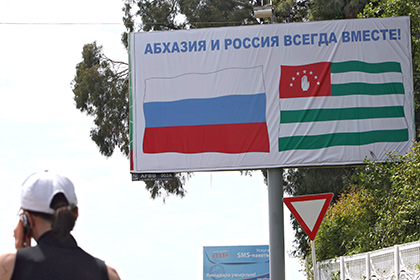
"They Will Definitely Fight for Our Lives There" — Why Abkhazians Prefer to Seek Treatment in Georgia Rather Than Russia
05/08/2020 16:39:31 Conflicts
Problems, crisis, collapse, catastrophe. None of these words fully captures the situation that has developed in Abkhazia in the fight against the new coronavirus infection. According to the official version of the republic's authorities, the situation is under control and everything needed to treat those infected is available. But in reality, things are far from rosy. The Gudauta Covid hospital is operating at the absolute limit of its capacity, treating patients with supplies that are already running short. Add to that the absence of protective equipment and disinfectants, and the picture becomes considerably grimmer.
Last Sunday, Abkhazian society was shaken once again. In addition to Russia's friendly sanctions, the open border, and the pension crisis, the republic's population learned of the dire situation in the healthcare system. It was not as though everything had been fine before and the crisis had struck suddenly — but Abkhazian society was simply unprepared for a situation in which the number of patients grows exponentially while the medications to treat them, and the conditions in which to do so, are simply absent.
On August 2nd, the operational headquarters for combating coronavirus at Abkhazia's Ministry of Health made a stunning announcement. Its essence, in brief, was that "coping with the flow of patients is extremely difficult, and if we add to our own population those who will arrive, we will simply be overwhelmed and unable to provide assistance to either our own citizens or anyone else." The majority of Abkhazian medical workers agreed with this assessment and, seeing what was happening, decided not to keep the problem silent.
And a problem there is, as it turned out. The first to bear the brunt were medical workers, who lacked even the most basic protective equipment — specialized suits, gloves, masks, and much else besides. The republic's only Covid hospital is itself not prepared to receive patients. Treatment is being carried out according to the most rudimentary protocol, one that includes medications already discontinued by the World Health Organization. But there are no others in Abkhazia, and there are unlikely to be any in the near future.
The unvarnished truth from the mouths of doctors plunged the population into a state of shock for a time. Abkhazia's authorities, realizing that calm might soon give way to a storm, hastily set about refuting the doctors' arguments, calling on those who had "succumbed to panic to resign from the system." This did nothing to improve the situation — even despite the emergency arrival from Moscow of a rather impressive delegation of medical personnel. And for the first time during the pandemic, senior Russian officials began speaking about assistance in treating infected patients.
"We are additionally deploying a ward in Sochi for patients, in case tourists and vacationers need to be transported directly to Russian territory," said Russia's Minister of Health Mikhail Murashko on Monday during a working visit to Sochi. Shortly afterward, the commission from the Russian Ministry of Health confirmed its intention to transfer to Sochi clinics not only tourists, but residents of Abkhazia as well — with one important clarification: medical assistance would be provided to residents of the republic who hold Russian citizenship. Those without a Russian passport would have to rely on their own healthcare system or their own pocket.
The Russian Ministry of Health recommended that the doctors who had expressed concern about the rising infection rate, drawn attention to the shortage of staff and medications, and generally identified the scale of the problem, be dismissed.
Yet another set of harsh "recommendations" inevitably prompts the question: by what right do Russian officials decide for Abkhazians who should work and who should be shown the door? So doctors who care with all their heart about the future of Abkhazia and its citizens in such a difficult situation are supposed to keep silent? It is some kind of theater of the absurd. And most remarkably of all — the Russian state dictates conditions, the failure to comply with which could threaten the young republic with yet another round of harsh sanctions.
Instead of help and support, the republic has received from Russia, throughout the entire pandemic, nothing but a ban on the purchase of medications, protective equipment, and even ventilators. The strategic partner forbids Abkhazian citizens from carrying even a pair of protective masks across the state border. If more than one such mask is found in your bag, border guards draw up a confiscation report, and a resident of the republic may only proceed home after paying a fine.
So as not to aggravate the existing situation, Abkhazian medical workers are also compelled to conceal the fact that all the medications, protective suits, and even contactless thermometers available to local medicine have been received from international organizations — and not from Russia in any way.
The condition of those infected deteriorates with lightning speed. Children and pregnant women have already been infected. Although the border is open and Sochi is faster and easier to reach, patients with severe cases of the disease continue to be transported to Georgia. Several more people are already in the queue — having refused treatment at the Gudauta Covid center and demanding to be taken to a Tbilisi clinic. "We want to go to Georgia not only in the hope of modern medicine and equipment, but also because we know that there they will definitely fight for our lives. In Russia they don't treat their own properly — do you think they'll treat us any better?!" says M.A., a resident of Gagra.
The opening of the border with Russia came as a shock to Abkhazia's Ministry of Health. Instead of a phased lifting of restrictions with the introduction of Covid passports or medical certificates, the republic opened its borders without any conditions or controls whatsoever. No testing is being carried out, no quarantine is being observed, no self-isolation requirements enforced. Tourists are not even having their temperatures taken. No matter — residents of Abkhazia can also enter Russia without any of these checks, you might say. True enough. Except that, unlike the large neighbor, Abkhazia has a population of just 300,000. The majority are elderly people, plus those with disabilities and cancer patients — and even the younger population cannot particularly boast of robust health. The result is that in the event of the collapse so loudly predicted by doctors, there will be no one to save people from the deadly virus. Abkhazian medicine, already operating at the very limit of its strength and capacity, will be overwhelmed.
I hope this is not the end Russia wishes for its strategic partner and neighbor — a country to which, in its hour of need, it could not find the strength to extend a reliable and friendly helping hand.
Kristina Avidzba
The text contains place names and terminology used in the self-proclaimed Republic of Abkhazia. Opinions expressed in the publication reflect the views of the author and do not necessarily represent the position of the editorial board.